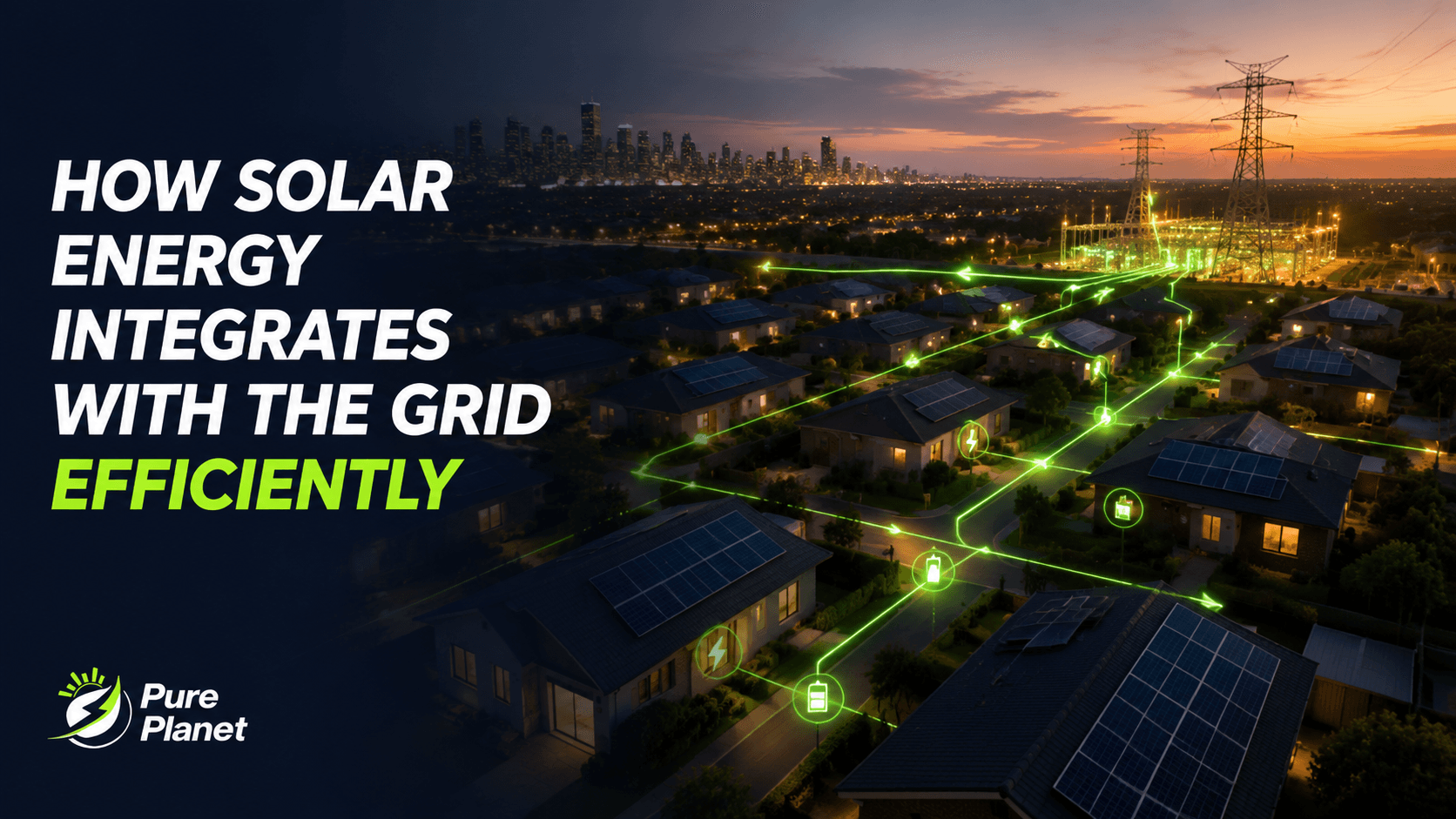
A grid-connected solar system doesn't just generate electricity it has an active, two-way relationship with the network that powers your suburb. Understanding how that relationship works helps you make smarter decisions about system size, battery storage, export timing, and tariff selection. This article explains exactly how solar energy integrates with the grid, from the inverter's first handshake to the future of whole-neighbourhood energy sharing.
Table of Contents
- 1.What "Grid-Connected" Actually Means
- 2.How the Inverter Syncs With the Grid
- 3.Your Home's Two-Way Energy Relationship
- 4.How Solar Energy Flows Through a Grid-Connected Home
- 5.Why Export Limits Exist, and How Batteries Solve Them
- 6.Getting More From Your Export: Timing Matters
- 7.Anti-Islanding: The Safety System Behind Every Grid-Tied Solar Install
- 8.Virtual Power Plants: Grid Integration at Scale
- 9.How to Maximise the Value of a Grid-Connected Solar System
- 10.Practical Tips for Smarter Grid Integration
- 11.Conclusion
Most people think of their solar system as a way to generate free power. It's that but it's also something more interesting. The moment your panels start producing, your system becomes an active participant in the electricity grid, constantly communicating with the network, responding to its frequency, and deciding in real time where each kilowatt goes. Most homeowners never know this is happening. But understanding it changes how you think about your system, your tariff, and how much you're actually saving.
What "Grid-Connected" Actually Means
There are two types of solar systems: off-grid and grid-connected. Off-grid systems are standalone; they rely entirely on batteries and generate no connection to the wider network. They're common in remote rural properties where running a power line isn't practical.
Almost every urban and suburban solar installation in Australia is grid-connected. This means your home remains physically linked to the electricity network even after panels go on the roof. The grid serves two purposes in this setup: it acts as a backup when your solar and battery can't cover your demand, and it becomes a destination for any surplus power your system produces.
This connection is managed not passive. Your system has to meet Australian Standard AS/NZS 4777.2 before it can legally connect, which sets strict rules on how your inverter must behave relative to the grid. Pure Planet handles all compliance and grid connection approval as part of every installation.
How the Inverter Syncs With the Grid
This is the part most people have never heard about and it's genuinely fascinating.
Your solar panels produce direct current (DC) electricity. The grid runs on alternating current (AC) at exactly 50 hertz (Hz) in Australia, meaning the current alternates direction 50 times per second. Before your solar power can flow into your home or back to the grid, your inverter must convert DC to AC and match that frequency precisely.
This process is called grid synchronisation. Your inverter continuously monitors the grid's live frequency and voltage, then adjusts its own output to stay perfectly in step. If the grid shifts even slightly, say, to 49.8Hz during a period of heavy load your inverter detects this within milliseconds and responds.
This matters because electricity that's even slightly out of sync with the grid doesn't flow properly. A quality inverter from brands like Fronius, SMA, or Sun grow the inverters Pure Planet installs handles this synchronisation automatically and continuously, ensuring your solar generation feeds into your home and the grid cleanly and without waste.
Your Home's Two-Way Energy Relationship
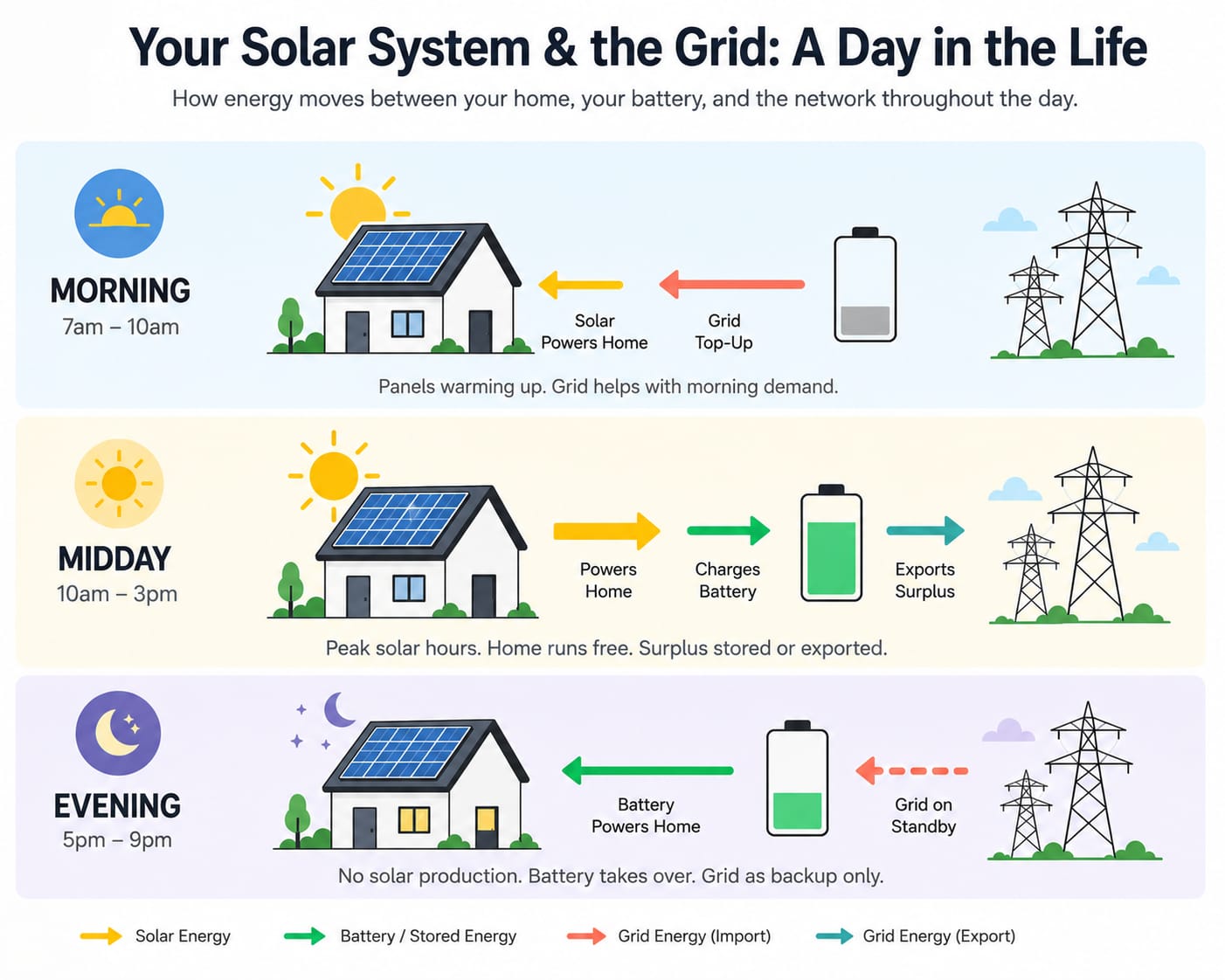
Once your system is live and synchronised, your home enters a continuous energy balancing act throughout every day. The priority order is always the same:
1. Power your home first Every kilowatt your panels produce goes to your appliances before anything else. Running the dishwasher, the fridge, the TV, all of this draws from your panels first, at zero cost to you.
2. Charge your battery If there's more solar production than your home needs, a home battery stores the surplus. This captured energy is then available after sunset, covering the evening peak hours without drawing from the grid.
3. Export what's left Once the battery is full (or if there's no battery installed), any remaining surplus flows out to the grid. Your smart meter records this export and your energy retailer credits your account at the feed-in tariff rate.
4. Draw from the grid when needed On cloudy days, at night, or during periods of high household demand, the grid fills in whatever your panels and battery can't cover. You're billed only for this net consumption.
This four-step cycle repeats dynamically throughout the day. A well-designed system maximises Steps 1 and 2, meaning you're buying as little as possible from Step 4. To understand how calculating your specific savings works, our guide on how to calculate energy savings from solar panels walks through the maths in detail.
How Solar Energy Flows Through a Grid-Connected Home
Why Export Limits Exist, and How Batteries Solve Them
As solar adoption has grown across Australia, network operators have had to manage an unexpected challenge: too much power flowing back at once.
When thousands of households in the same suburb all export surplus solar at midday, it can push more electricity into the local network than it was built to handle. To prevent this, Distribution Network Service Providers, companies like Powercor, United Energy, and CitiPower in Victoria, impose export limits on residential connections. Most single-phase homes are limited to exporting 5kW per phase.
If your system produces 8kW at peak midday output but the limit is 5kW, the extra 3kW is effectively wasted the inverter throttles its own output and the energy disappears.
A battery solves this completely. Instead of losing that 3kW to the throttle, a battery captures it during the middle of the day and releases it in the evening either to power your home or to export during off-peak hours when the network constraint is lifted. You lose nothing, and you earn credits at a potentially better tariff rate.
This is one of the strongest financial cases for battery storage that most households aren't aware of. For a deeper look at how home batteries improve energy independence, see our dedicated guide.
Getting More From Your Export: Timing Matters
Not all exported electricity earns the same credit. As of 2026, Victoria's energy market has moved toward time-varying feed-in tariffs (FiT) , plans where the rate you receive for your export changes depending on the time of day.
Here's what the typical structure looks like:
The implication is clear: exporting during the midday solar glut earns you very little. Exporting in the late afternoon or early evening when the grid actually needs your power earns three to four times more per kilowatt.
A battery lets you hold your midday surplus and release it during the high-value evening window instead, turning a 4-cent export credit into a 15-cent one. Over a year, this difference in timing can be worth hundreds of dollars for a well-configured household.
This is something Pure Planet considers at the design stage ensuring your battery capacity, inverter settings, and tariff plan are aligned to maximise your export value, not just your export volume.
Anti-Islanding: The Safety System Behind Every Grid-Tied Solar Install
There's a safety feature built into every grid-connected inverter that most homeowners have never heard of: anti-islanding protection.
When the grid goes down — during a blackout or maintenance work utility workers need to de-energise the network so they can work on it safely. The risk with solar homes is that panels could keep pumping power into a supposedly dead section of the network, creating a dangerous "island" of live electricity that workers don't expect.
Anti-islanding protection prevents this. Your inverter continuously monitors the grid's presence. The moment it detects the grid has gone offline, it shuts down your solar export within 2 seconds. This is mandatory under Australian Standard AS/NZS 4777.2 and applies to every grid-tied system in the country.
The practical implication for homeowners: a standard grid-tied solar system without battery backup will not power your home during a blackout, even if the sun is shining. This surprises many people who assume solar means automatic backup.
A battery system configured in "island mode" or "backup mode" changes this. When the grid goes down, the battery and inverter form their own small grid inside your home, keeping your essentials running until the network comes back. Pure Planet's team ensures every battery installation is correctly configured for this functionality during commissioning.
Virtual Power Plants: Grid Integration at Scale
Individual solar homes integrate with the grid one household at a time. Virtual Power Plants (VPPs) take this a step further by connecting hundreds or thousands of home batteries into a coordinated network that can respond to grid demand as a single unit.
When the grid is under stress say, a hot summer afternoon when air conditioners are running across the state the VPP operator sends a signal to all enrolled batteries. Each battery discharges a portion of its stored energy to the grid simultaneously. The combined effect is equivalent to a small power station switching on within seconds, stabilising the grid and preventing outages.
In return, homeowners earn credits for their participation. It's essentially a passive income stream from energy your system was already storing.
Pure Planet installs batteries compatible with VPP programs, and our team advises on the best enrollment options based on your retailer and location. For a full explanation of how these programs work, our Virtual Power Plants guide covers the details.
💡 Pro Tip
Check your electricity retailer's export tariff schedule before you assume your current plan is the best one. Many households are on flat-rate feed-in tariffs that pay the same regardless of when they export. A time-varying tariff from a different retailer combined with a battery that can hold your midday surplus until the evening peak can meaningfully increase what you earn from the grid each quarter. Switching retailers costs nothing and takes about 10 minutes online. Your installer can point you toward the plans worth comparing.
How to Maximise the Value of a Grid-Connected Solar System
Installing a grid-connected solar system is only the first step. To maximise its value, it's important to use as much of your solar energy as possible instead of exporting it during low-value periods. Running high-energy appliances such as washing machines, dishwashers, or pool pumps during daylight hours increases self-consumption and reduces the amount of electricity you purchase from the grid.
For households with battery storage, setting charging and discharge schedules around your electricity tariff can further improve savings. Regularly monitoring your inverter app also helps identify performance issues early, ensuring your system continues to operate efficiently. By combining the right system design, smart energy habits, and ongoing monitoring, homeowners can achieve greater long-term savings and make better use of every kilowatt generated.
Practical Tips for Smarter Grid Integration
These steps help you get more value from your grid connection regardless of which system you have:
Check your export limit — contact your Distribution Network Service Provider or ask Pure Planet to confirm your approved export limit. If your system regularly hits it at midday, a battery will pay for itself faster than you might expect.
Review your tariff annually — the feed-in tariff landscape changes every year. Compare what you're receiving against current market offers. Energy Made Easy (the government's comparison tool) makes this straightforward.
Use time-of-use scheduling in your battery app — set your battery to hold charge through the afternoon and begin discharging from 4pm onward. This captures the high-value export window automatically.
Monitor inverter alerts — your inverter app shows if the system is throttling export due to grid limits or frequency deviations. If you see this happening regularly, it's a signal your system design could be optimised.
Ask about VPP eligibility — if your battery is already installed, ask your retailer or Pure Planet whether it qualifies for a VPP program in your area. Enrollment is usually free and the credits add up over time.
For more on tracking your system's real-time performance, see our guide on how to monitor solar system performance effectively.
Conclusion
Your solar system doesn't exist in isolation it's part of a living, dynamic network that balances supply and demand across your entire region. Every kilowatt your panels produce either powers your home, charges your battery, or supports the grid that your neighbours rely on. Understanding how this relationship works is what separates a solar system that just saves money from one that's genuinely optimised.
At Pure Planet, every system we design accounts for grid synchronisation, export limits, tariff timing, and battery configuration from day one. The result is a system that works harder for you not just on sunny days, but through every hour of every season.
Ready to find out how much a well-integrated solar system could save your household? Request a free assessment and our team will walk you through the numbers.