A practical guide for Victorian businesses considering commercial solar: how to size a system against your actual daytime usage instead of your roof, what the 30kW-100kW range really means, why 100kW is a meaningful cutoff, and what a realistic payback looks like.
Table of Contents
- 1.How Commercial Solar Sizing Differs From Home Solar
- 2.Start With Your Business's Electricity Usage
- 3.What 30kW to 100kW Commercial Solar Systems Can Power
- 4.What Determines the Right Commercial Solar System Size?
- 5.What Changes When a Commercial Solar System Exceeds 100kW?
- 6.How Commercial Solar Payback Is Calculated
- 7.Sizing Mistakes That Cost Businesses Money
- 8.Conclusion
A warehouse in Ravenhall and a cafe in Ringwood should never end up with the same size solar system but ask around for quotes and you'll often get one anyway. Most sizing conversations start and end with roof space: "how many panels can we fit up there?" That question tells an installer almost nothing about whether the system will actually pay for itself in three years or sit there quietly under-delivering for the next fifteen.
The businesses that get the most out of commercial solar are the ones that size the system around how they actually use power, not around what fits on the roof. This guide walks through how that sizing decision should really work, what the 30kW–100kW range means in practice, and the mistakes that quietly cost Victorian businesses money.
How Commercial Solar Sizing Differs From Home Solar
Home solar sizing is fairly forgiving. Most households export a chunk of what they generate during the day and use the rest at night off the grid or a battery, so getting the size slightly wrong doesn't change the maths much either way.
Commercial sizing doesn't have that cushion. A business system is built to offset a specific daytime load: refrigeration running all day, machinery on a shift pattern, HVAC keeping a showroom comfortable during trading hours. Oversize it and you're exporting expensive-to-build capacity at low feed-in rates. Undersize it and you're still buying peak-rate grid power during the exact hours your solar should have covered it. Our guide to residential vs commercial solar differences goes deeper on how the two setups diverge, but sizing is where it matters most it's where the return on investment actually comes from.
Start With Your Business's Electricity Usage
Before any sizing conversation is worth having, pull twelve months of electricity bills, not one. Businesses are seasonal: a cool room draws more in summer, a heated workshop draws more in winter and a single month can badly misrepresent what a system needs to cover.
From there, the two numbers that actually matter are:
- Average daytime consumption (kWh used roughly 9am–4pm, when solar is generating) this is what the system should be sized against, not your total daily usage
- Peak demand (the highest draw your site hits, often during equipment start-up or a hot afternoon with cooling running flat out) this affects inverter and switchboard sizing, not just panel count
A café open 7am–3pm has a completely different load shape to a 24-hour cold storage facility, even if their monthly bills look similar. The system that makes financial sense for one would be the wrong call for the other our post on the key differences between home and business solar systems breaks down why load shape changes the whole design, not just the size.
What 30kW to 100kW Commercial Solar Systems Can Power
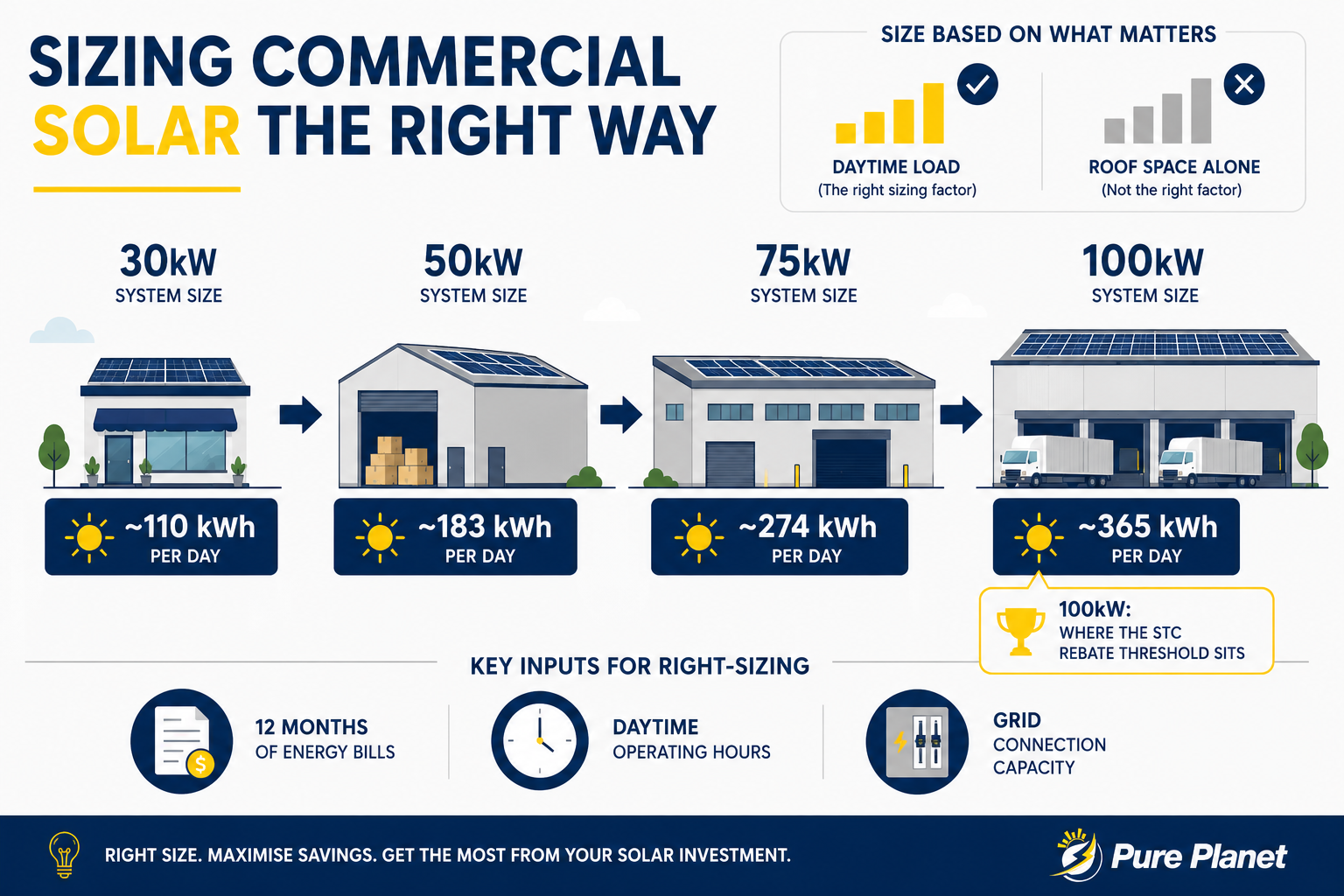
Pure Planet's commercial and residential solar panel systems run from 30kW up to 100kW, which covers most small-to-medium Victorian businesses from a single retail site to a larger warehouse or light-industrial operation. Here's roughly what each tier looks like in daily output, based on Melbourne's average solar conditions:
Estimates based on Melbourne's average solar conditions and standard system performance actual output depends on roof orientation, shading, and panel efficiency, and will be confirmed against your site's real load data during design. Want a rough starting number for your own site? Our solar calculator gives you a quick first estimate before you speak to us.
These aren't hard boundaries; a business sitting between two tiers is common, and the right number is whatever matches your actual daytime load, not the nearest round figure.
What Determines the Right Commercial Solar System Size?
Once the load data is in hand, a handful of site-specific factors shape the final number:
- Roof space and orientation — north-facing roof area is the ceiling on what's physically possible, but it's a constraint, not the starting point
- Operating hours — a site running 9-to-5 gets far more value per kW installed than one that's mostly closed during daylight hours
- Switchboard and grid connection capacity — larger systems sometimes need switchboard upgrades or a formal application to the local distribution network, which affects both cost and timeline
- Planned growth — new equipment, an extra shift, or an EV delivery fleet on the horizon can justify sizing slightly ahead of today's usage rather than re-doing the job in three years
- Battery plans — a business wanting backup power or looking to manage peak demand charges may deliberately size solar differently than one going panels-only
What Changes When a Commercial Solar System Exceeds 100kW?
There's a practical reason commercial quotes tend to cluster under 100kW rather than drifting past it: that's roughly where the federal Small-scale Renewable Energy Scheme stops applying. Systems under that threshold generate Small-scale Technology Certificates (STCs) , the same upfront discount mechanism used on residential systems applied directly at the point of sale. Push past it and a system generally moves into Large-scale Generation Certificate territory instead, which works completely differently and isn't paid upfront the same way.
In practice, this means a 95kW system and a 105kW system can have a meaningfully different cost structure, even though they look almost identical on a roof. It's one of the reasons a proper sizing conversation happens before a quote, not after the difference isn't just panels, it's which rebate scheme the system qualifies under.
One thing worth being upfront about: the residential Solar Victoria rebate (the $1,400 homeowner rebate) is an owner-occupier program with its own income and property criteria that doesn't apply to commercial systems. Our FAQs page 🟢 covers exactly who the residential rebate applies to, if you're weighing up a mixed-use or multi-title property. Commercial solar's financial case is built on STCs, the electricity you stop buying at commercial tariff rates, and depreciation worth confirming the specifics with your accountant, since eligible deductions vary by business structure.
How Commercial Solar Payback Is Calculated
Commercial electricity tariffs typically run 30–45 cents/kWh notably higher than what most households pay and because businesses tend to use most of their power during business hours, a correctly sized system offsets a much larger share of that expensive daytime usage than a home system does. That's the core reason commercial solar tends to pay back faster than residential, which our post on how commercial solar systems save businesses money 🟢 covers in more detail: Pure Planet's commercial systems are typically estimated around a 3.5-year payback, versus the 3–5 years more common on residential installs.
That number moves depending on your actual tariff, your daytime usage pattern, and how closely the system size matches your load which is exactly why the sizing step at the start of this guide has more influence on your ROI than almost anything else in the process.
💡 Pro Tip
Before you request quotes, size your system against your average daytime kWh usage from your last twelve months of bills, not your total monthly usage, and not your roof space. A system sized to your actual daytime load, even if it means a slightly smaller install, will usually out-earn a bigger system that spends half its output being exported at low feed-in rates.
Sizing Mistakes That Cost Businesses Money
A few sizing mistakes come up again and again in commercial quotes:
- Sizing off "how much roof is there" instead of "how much power do we use during the day" the single most common error, and the one that most affects payback
- Using one month of bills instead of twelve, a summer-only or winter-only snapshot misses seasonal load swings that change the right size
- Ignoring switchboard capacity until after the panels are ordered, an undersized switchboard can mean a costly mid-project upgrade
- Not planning for known future load, new equipment or an EV fleet arriving next year is far cheaper to size for now than to retrofit later
- Treating 30–100kW as one-size-fits-all, a distribution centre and a single-site retailer both fit "commercial," but almost never the same system
Conclusion
Getting commercial solar sizing right comes down to one thing: matching the system to your business's actual daytime load, not your roof space or a round number. Pure Planet works through that sizing process as part of every commercial solar assessment, so the 30kW–100kW system you end up with is built around your real usage, not a guess. Get a free commercial solar quote and find out what size and what payback actually fits your business.