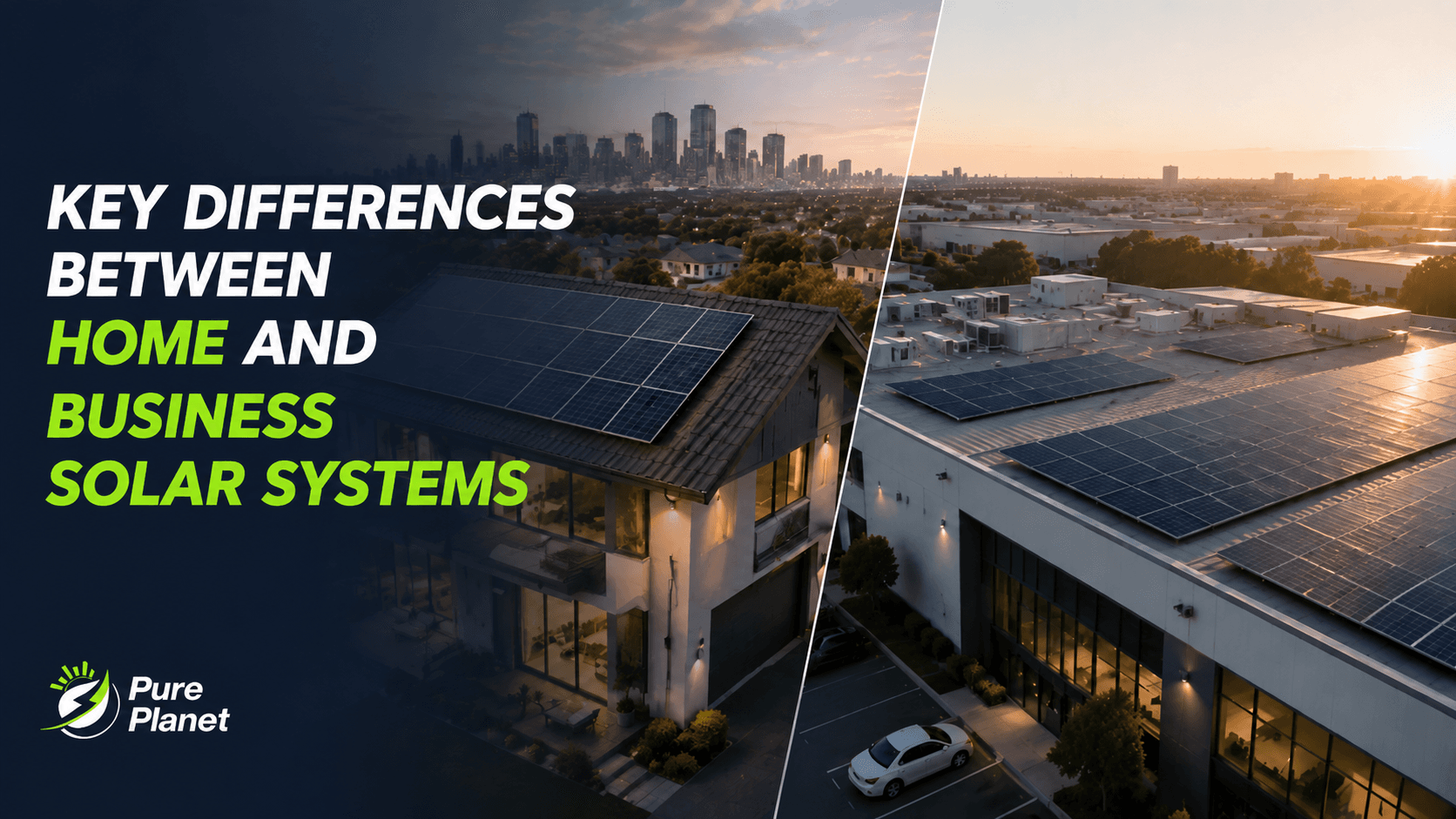
Solar panels work the same way whether they're on a family home or a factory roof , but the systems behind them are built differently, priced differently, and supported by different government programs. This article breaks down the key practical differences between home and business solar so you can understand what actually changes and why it matters for your decision.
Table of Contents
- 1.Why the Same Technology Works Very Differently
- 2.System Size and Daily Energy Output
- 3.Single-Phase vs Three-Phase Grid Connection
- 4.How Rebates and Incentives Differ
- 5.For Homeowners (Victoria)
- 6.For Businesses
- 7.Home Solar vs Business Solar: At a Glance
- 8.How Battery Storage Fits Into Each Setting
- 9.At Home
- 10.At a Business
- 11.Monitoring, Maintenance, and Compliance
- 12.Home Systems
- 13.Business Systems
- 14.Which Solar System Is Right for Your Property?
- 15.Before Choosing a Solar System, Ask Yourself:
- 16.💡 Pro TipIf you run a business and are considering solar, get your energy audit done before the end of the financial year. Systems designed and quoted in May or June can be installed and commissioned in time for the EOFY cutoff, making the full system cost eligible for that year's instant asset write-off. This single piece of timing can move the effective payback period forward by 12 months or more. Contact Pure Planet in April to allow enough time for design, approval, and installation.
- 17.Practical Tips for Choosing the Right System
- 18.Conclusion
Most people assume that a business solar system is just a bigger version of what goes on a house. It isn't. The size is just the start of the grid connection, the rebate programs, the way batteries are used, and even the compliance requirements are all meaningfully different. Getting this wrong doesn't just cost money upfront; it means years of underperforming savings.
Whether you're a homeowner trying to cut your electricity bill or a business owner looking to protect your bottom line from rising energy costs, understanding these differences upfront will save you time, money, and a lot of confusion.
Why the Same Technology Works Very Differently
A solar panel converts sunlight into electricity regardless of where it's installed. But the system surrounding those panels, the inverter, the grid connection, the storage, and the monitoring is designed around one core question: when does this property use its energy?
A household typically uses most of its energy in the early morning and evening, when no solar is being produced. A business usually runs during daylight hours, which means it can use solar power directly as it's being generated.
This single difference in usage pattern drives almost every other design and financial decision. It's why home solar systems are designed around self-consumption and storage, while commercial systems are built for high-volume daytime output and demand charge management.
System Size and Daily Energy Output
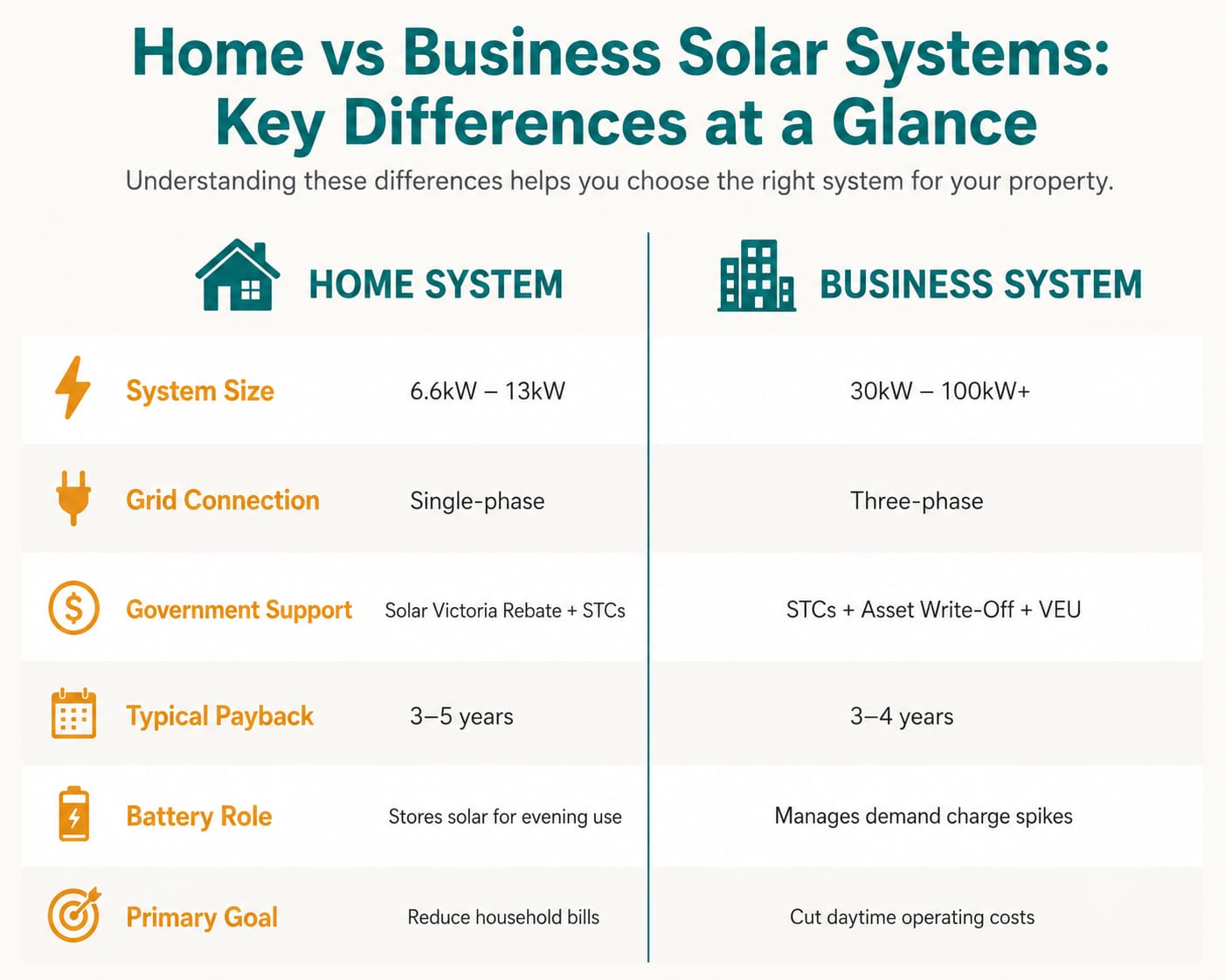
The most visible difference is size. A typical home system ranges from 6.6kW to 13kW, using 16 to 30 panels on a pitched residential roof. This covers the daily energy needs of most Australian households and usually leaves enough surplus to charge a battery or feed back to the grid.
A business solar system starts where residential systems end. For small commercial premises a café, an office, a warehouse systems typically begin at 30kW and scale up to 100kW or beyond depending on the site. Larger industrial or agricultural installations can reach the megawatt range.
The key point isn't just that business systems are bigger, it's that they're sized to match the specific energy profile of the operation. A cold storage facility running at full capacity 24/7 needs a very different system design compared to a retail shop open 9am to 5pm. Pure Planet conducts a full energy audit before designing any commercial system to ensure the output matches the actual load.
Single-Phase vs Three-Phase Grid Connection
Most homes in Australia are connected to the electricity grid on a single-phase connection. This means the system handles power on one circuit and is subject to a maximum export limit typically 5kW per phase in most states. It's perfectly suited to a household, but it does limit how much power a solar system can push back to the grid at any one time.
Businesses almost always operate on a three-phase connection. This supports heavier electrical loads motors, compressors, industrial refrigeration, commercial HVAC and allows for a much larger solar export capacity. A three-phase system can also distribute the solar generation more evenly across the business's electrical infrastructure, reducing internal load imbalances.
When Pure Planet designs a commercial solar system, the grid connection type is one of the first things assessed. Installing the wrong inverter configuration for your connection type creates efficiency losses and compliance issues that are expensive to correct later.
How Rebates and Incentives Differ
Both homeowners and business owners in Australia can access government support for solar but the programs are structured quite differently.
For Homeowners (Victoria)
Solar Victoria Rebate — up to $1,400 applied directly off the cost of your system at the time of installation
Interest-Free Loan — up to $1,400 repaid at $29.17 per month over four years; no interest
Federal STCs (Small-scale Technology Certificates) — a federal scheme that provides an upfront discount of $2,000–$3,000 depending on system size and location
Eligibility requirements — you must own the property, have a combined household income under $150,000, and the property must be valued under $3 million
To understand your specific entitlements before installation, read our guide on how solar rebates work and who can claim them.
For Businesses
Federal STCs — also available for commercial systems up to 100kW; the discount scales with system size
Instant Asset Write-Off — eligible businesses can write off the full cost of the solar system in the year it's installed (subject to ATO rules for the relevant financial year)
VEU Credits (Victoria) — the Victorian Energy Upgrades scheme provides certificate-based incentives for commercial energy efficiency upgrades, which can include solar in certain configurations
No income or property value limits — commercial rebates are not subject to the same means-testing as residential programs
The financial impact for a business can be substantial. A commercial system costing $80,000 with applicable tax deductions and STCs might have a net effective cost closer to $50,000–$55,000 after incentives. Pure Planet manages all paperwork and rebate applications for both residential and commercial clients.
Home Solar vs Business Solar: At a Glance
How Battery Storage Fits Into Each Setting
Batteries serve a different purpose depending on whether they're installed at a home or a business.
At Home
Because households use most of their power in the morning and evening outside of solar production hours — batteries are essential for maximising self-consumption. A home battery stores the surplus produced during the day and releases it in the evening, which means the household barely draws from the grid at all.
The NeoVolt and Fox ESS batteries Pure Planet installs are specifically designed for this pattern: high efficiency, long cycle life, and smart app-based scheduling to align with each household's routine.
At a Business
Businesses use most of their power during the day, which means they can consume solar power directly as it generates no storage needed for the core load. Batteries at commercial sites serve a different function: demand charge management.
Energy retailers charge businesses based on their single highest 30-minute power draw within the billing period. By discharging a battery during moments of peak activity such as when multiple machines start simultaneously the business flattens its consumption spike and avoids the demand charge penalty. This alone can represent thousands of dollars in annual savings for a medium-to-large operation.
For businesses also exploring participation in grid stability programs, batteries can be integrated into a Virtual Power Plant arrangement that generates additional income during periods of high grid demand.
Monitoring, Maintenance, and Compliance
Both system types require monitoring and periodic maintenance, but the requirements differ in scope.
Home Systems
Residential systems are monitored through the inverter's app (Fronius, SMA, Sungrow, or Enphase depending on the model installed). Homeowners can check daily production figures, spot underperformance, and receive alerts from their phone. Physical maintenance involves cleaning the panels occasionally and ensuring no shade has grown across the array from nearby trees.
Business Systems
Commercial installations require a more structured approach. In Victoria, systems above a certain capacity are subject to mandatory metering requirements and must comply with Australian Standard AS/NZS 4777.2. Businesses also need to track their solar output for financial reporting purposes especially if they're claiming tax deductions based on the asset's depreciation schedule.
Pure Planet provides clear documentation for all commercial installations, covering grid connection certificates, metering configurations, and the output data businesses need for their accountants.
For tips on tracking your system's performance accurately, our guide on how to monitor solar system performance covers both residential and commercial approaches.
Which Solar System Is Right for Your Property?
Choosing between a residential or commercial solar system isn't simply about the size of the building, it depends on how your property uses electricity. Homes generally benefit from systems designed to maximise self-consumption and battery storage, while businesses often achieve greater savings by offsetting large daytime energy loads.
Factors such as your electricity bills, operating hours, available roof space, future energy requirements, and budget should all be considered before selecting a system. A professional energy assessment helps determine the ideal system size, expected annual energy production, and available government incentives. By designing the system around your property's actual energy profile rather than using a standard package, you can maximise long-term savings and improve overall return on investment.
Before Choosing a Solar System, Ask Yourself:
✅ When do I use most of my electricity?
✅ Is my property single-phase or three-phase?
✅ Am I planning to install an EV charger or battery?
✅ Which rebates am I eligible for?
✅ How much roof space is available?
💡 Pro Tip
If you run a business and are considering solar, get your energy audit done before the end of the financial year. Systems designed and quoted in May or June can be installed and commissioned in time for the EOFY cutoff, making the full system cost eligible for that year's instant asset write-off. This single piece of timing can move the effective payback period forward by 12 months or more. Contact Pure Planet in April to allow enough time for design, approval, and installation.
💡 Pro Tip
If you run a business and are considering solar, get your energy audit done before the end of the financial year. Systems designed and quoted in May or June can be installed and commissioned in time for the EOFY cutoff, making the full system cost eligible for that year's instant asset write-off. This single piece of timing can move the effective payback period forward by 12 months or more. Contact Pure Planet in April to allow enough time for design, approval, and installation.
Practical Tips for Choosing the Right System
Whether you're going solar at home or at your business, these steps will help you make a confident decision.
Know your usage patterns first — pull out three months of electricity bills and identify when your peak usage occurs. A solar system designed around your actual pattern will always outperform a generic one sized only by roof space.
Ask about your grid connection type — before getting quotes, check whether your property is single-phase or three-phase. This affects inverter selection and maximum system size. Your electricity retailer or an electrician can confirm this in minutes.
Don't size for today only — if you're planning to add an EV, a heat pump, or expand your business operations, factor future loads into the system design now. Oversizing slightly today is far cheaper than adding panels and a new inverter later.
For businesses: check EOFY timing — as noted above, installation timing relative to the financial year can significantly affect the real cost of the system through tax depreciation.
Check your rebate eligibility before signing anything — for homes, confirm your household income and property value are within the Solar Victoria program's limits. For businesses, confirm the system size qualifies for STC calculation and whether the instant asset write-off applies to your entity type.
Use the Pure Planet savings calculator to get an initial estimate of what a system could save at your property before booking a consultation.
Conclusion
Choosing between a home and business solar system is about more than selecting a system size. Your energy usage, grid connection, available rebates, and long-term goals all influence the best solution for your property. Understanding these differences helps you invest in a system that delivers reliable performance, greater energy savings, and a stronger return on investment.
Whether you're powering a family home or a commercial facility, Pure Planet designs tailored solar solutions based on your property's unique energy profile. From system design and rebate applications to installation and ongoing support, our team is here to help you make a confident switch to renewable energy. Contact us today to arrange a free assessment and discover the right solar solution for your needs.
If you're ready to find out what makes sense for your property, request a free assessment and our team will walk you through the options with clear numbers.