Compare residential and commercial solar systems. Learn about differences in scale, panel technology, and installation for Melbourne homes and businesses.
Table of Contents
When exploring renewable energy options in Australia, it is important to recognise that "solar" is not a one-size-fits-all solution. While the core technology of converting sunlight into electricity remains the same, the application of that technology varies significantly between a suburban family home and a large-scale business warehouse. Understanding the key differences between residential and commercial solar systems ensures you choose the right configuration for your specific energy demandsss.
At Pure Planet, we provide tailored solutions for both sectors. Whether you are looking to eliminate your household power bill or protect your business from rising operational costs, our team designs systems that account for the unique structural and electrical requirements of your property.
Scale and Energy Capacity
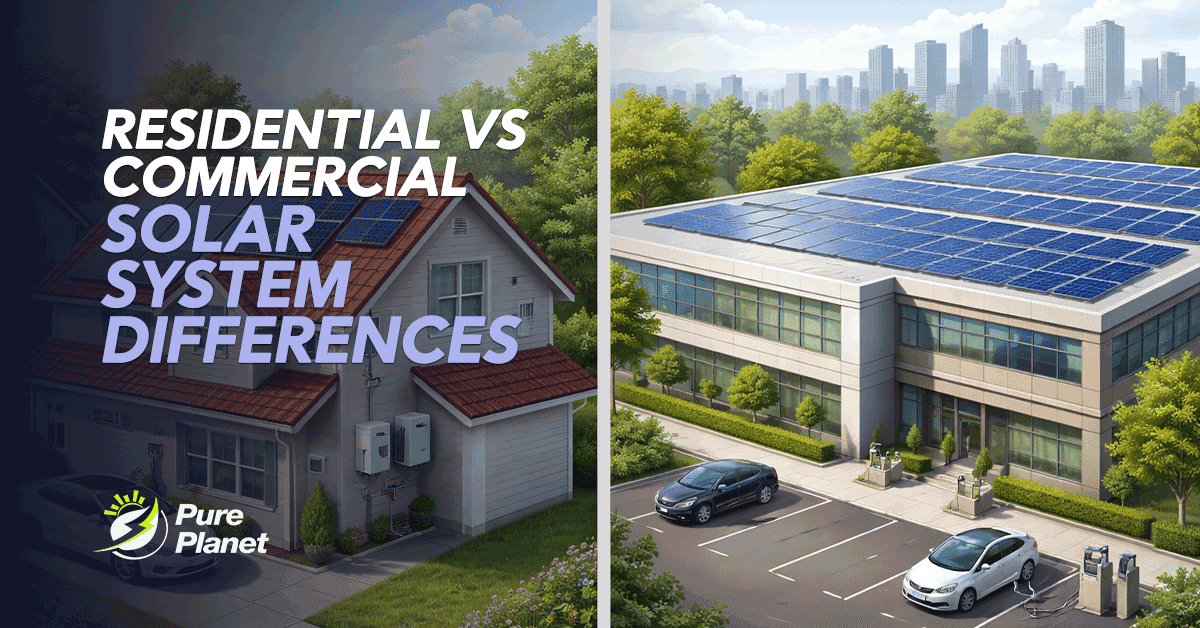
The most obvious differentiator is the physical size and power output of the system. A typical residential solar installation in Melbourne usually ranges from 6.6kW to 13.2kW, which is sufficient to cover the daily needs of an average family. These systems are designed to fit on a standard pitched roof and often prioritise "self-consumption" to keep the house running independently during the day.
Commercial systems, on the other hand, are significantly larger. Depending on the size of the enterprise, a commercial setup can range from 30kW to several megawatts (MW). These installations are designed to power heavy machinery, extensive lighting, and large HVAC systems. Because businesses often operate primarily during daylight hours, the goal of a commercial system is to provide a high volume of instantaneous power to offset expensive peak-hour commercial tariffs.
Differences in Panel Technology and Efficiency
While they look similar from a distance, the panels used in residential and commercial settings often differ in their cell count and physical dimensions. Residential panels are generally smaller and more lightweight (typically 60 or 66 cells), making them easier for installers to handle on steep, angled roofs. Homeowners also tend to prioritise aesthetics, often choosing "all-black" panels that blend seamlessly with modern roof tiles.
In contrast, commercial solar projects often utilise larger 72-cell or 144-cell bifacial panels. These panels are designed for maximum power density and durability. Since commercial roofs are often flat and hidden from public view, the utilitarian "silver frame" design is common. These larger panels produce more wattage per unit, which helps lower the overall "cost per watt" for the business, even if the total project cost is higher.
Installation Complexity and Mounting Systems
The process of physically attaching solar panels to a roof changes drastically between the two sectors. Residential installations involve mounting panels on pitched roofs made of tile or Colorbond, requiring specialised brackets that must be drilled into the rafters. This process usually takes one to two days and requires a high level of precision to ensure the roof remains watertight.
Commercial buildings often have expansive flat roofs, which allows for "ballasted" mounting systems. These systems use weighted blocks to hold the panels in place without actually piercing the roof membrane. This non-invasive method is much faster for large-scale arrays but requires a detailed structural engineering report to ensure the roof can support the added weight. While the actual panel laying is fast, the electrical integration for a commercial site is far more complex, often requiring high-voltage three-phase inverters.
Financial Incentives and Payback Periods
Both homeowners and business owners in Victoria can access significant financial support, but the programs are structured differently. Residential systems benefit from the Solar Homes Program rebate and interest-free loans, which focus on making technology affordable for families. These systems usually have a "payback period" of 3 to 5 years, after which the electricity produced is entirely profit for the household.
Business owners can often access even larger incentives, including accelerated depreciation and the Investment Tax Credit (ITC). Because commercial systems generate so much power, the return on investment (ROI) can be even more attractive. Many businesses find that their solar system pays for itself quickly by significantly reducing their taxable income and their monthly overheads.
Conclusion
Choosing between a residential or commercial approach depends entirely on the scale of your energy needs and the nature of your property. While residential systems focus on aesthetics and household independence, commercial systems are built for high-output performance and financial efficiency. Regardless of the scale, both systems offer a pathway to a cleaner, more affordable energy future in Melbourne.
At Pure Planet, we have the expertise to manage the complexities of both residential and commercial projects. From initial site audits and engineering to final grid connection and rebate processing, we ensure your solar journey is smooth and profitable. Contact our team today to discuss which solar solution is the right fit for your property and start your transition to renewable energy.