Heat pump hot water systems are low-maintenance by design but "low maintenance" is not the same as "no maintenance." A few simple checks done regularly protect your warranty, extend the life of your system, and keep your household safe. This guide walks through exactly what you can do yourself and what needs a licensed professional.
Table of Contents
- 1.Why Maintenance Matters More Than Most People Realise
- 2.Simple Maintenance Schedule at a Glance
- 3.What You Can Handle Yourself vs. What Needs a Professional
- 4.How to Clean the Air Intake and Outdoor Unit
- 5.Testing the PTR Valve: A 30-Second Safety Check
- 6.Why Anode Rod Inspections Protect Your Tank and Warranty
- 7.Set the Right Temperature for Safety and Efficiency
- 8.When to Call a Heat Pump Technician
- 9.How Often Should Your System Be Professionally Serviced?
- 10.Does Regular Maintenance Save Money?
- 11.Conclusion
Why Maintenance Matters More Than Most People Realise
Regular maintenance keeps your heat pump running efficiently, protects the tank from corrosion, ensures your warranty stays valid, and eliminates safety risks like bacterial growth and pressure build-up. Without it, a system that should last 15–20 years can fail much sooner.
Modern heat pump hot water systems , like the Reclaim Energy, Sanden, and Stiebel Eltron units Pure Planet installs are built to handle Australian conditions with minimal upkeep. But neglecting the basics still has real consequences. Reduced airflow cuts efficiency and increases running costs. An unchecked pressure relief valve can become a safety hazard. An anode rod that hasn't been inspected in years allows the tank lining to corrode from the inside.
None of these are complicated problems to prevent, they just require knowing what to look for and when.
Simple Maintenance Schedule at a Glance
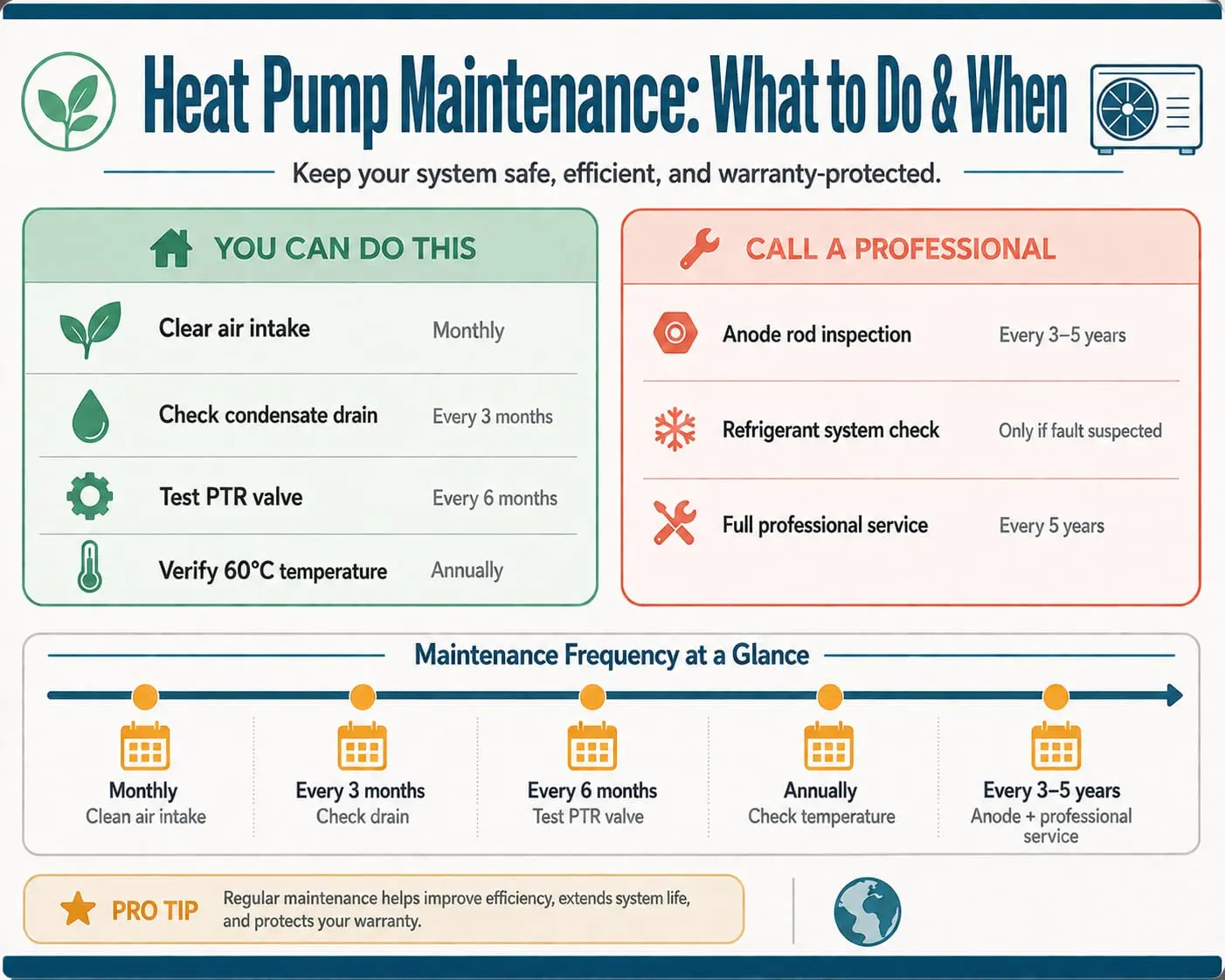
Keeping your heat pump in good condition doesn't require much time. Following a simple maintenance schedule helps improve efficiency, extends the system's lifespan, and keeps your warranty valid.
What You Can Handle Yourself vs. What Needs a Professional
Homeowners can safely carry out visual inspections, air intake cleaning, PTR valve testing, and temperature checks without any tools or trade qualifications. Tasks involving refrigerant, electrical components, or tank internals must be handled by a licensed technician.
How to Clean the Air Intake and Outdoor Unit
The outdoor unit draws in ambient air to extract heat, so anything blocking that airflow leaves, dust, cobwebs, or overgrown plants forces the compressor to work harder, consumes more electricity, and increases wear over time. A quick monthly check keeps the unit performing at its best.
Steps for cleaning the outdoor unit:
Turn off the system at the control panel before cleaning (not at the switchboard unless you're also inspecting connections)
Use a soft brush or dry cloth to remove dust, lint, and debris from the air intake grilles
Check that the fan area at the top is clear, leaves and seed pods frequently collect there
Maintain at least 300mm of clearance on all sides of the unit, and ensure nothing has grown or been placed too close
After heavy storms, always do a quick visual check for debris lodged in the grilles or around the base
Reclaim Energy and Sanden units both use quiet, efficient CO₂ compressors any significant increase in operating noise after cleaning is worth noting, as it may indicate a component issue.
Testing the PTR Valve: A 30-Second Safety Check
The pressure and temperature relief (PTR) valve is a critical safety device that releases water if the tank pressure or temperature exceeds safe limits. Australian plumbing standards recommend testing it every six months by lifting the lever briefly and allowing water to flow for a few seconds.
How to test it safely:
Locate the PTR valve it's usually on the side or top of the tank, with a discharge pipe running down to a drain
Stand to the side of the discharge pipe, not directly in front the water released is hot
Gently lift the lever for 3–5 seconds, then release
Water should flow freely from the discharge pipe and stop cleanly when you release the lever
If no water flows, if the valve drips continuously after release, or if it feels stiff, have it replaced by a licensed plumber do not attempt to repair it yourself
A faulty PTR valve is not something to delay on. It's a safety device and must work correctly.
Why Anode Rod Inspections Protect Your Tank and Warranty
The sacrificial anode rod sits inside glass-lined hot water tanks and slowly corrodes in place of the tank lining protecting the steel from rusting through. Once the anode is depleted, the tank itself begins to corrode, leading to leaks and early failure. Inspection is required every 3–5 years to maintain your warranty.
This applies specifically to glass-lined tanks, including Reclaim Energy's glass-lined models. Stainless steel tanks — such as those used by Sanden Eco Plus do not corrode and have no anode to inspect, which is one reason they're preferred for low-maintenance households.
For Reclaim Energy glass-lined systems, the manufacturer recommends:
First anode check at 5 years
Then every 3 years thereafter
Replacement if the anode has degraded beyond 50% of its original diameter
This inspection must be carried out by a licensed plumber. It's not expensive, and it's far cheaper than replacing a tank that failed due to corrosion. If you're in a hard water area (above 200mg/L), anode depletion happens faster ask your Pure Planet technician about water softening options at installation.
Set the Right Temperature for Safety and Efficiency
Your heat pump tank should be set to store water at 60°C. Below 55°C, Legionella bacteria which causes Legionnaires' disease can survive and multiply in standing water. At 60°C and above, these bacteria are eliminated within minutes.
This doesn't mean hot water comes out of your taps at 60°C. A tempering valve (required by Australian plumbing standards in most states) mixes cold water into the supply before it reaches the taps, delivering water at a safe 50°C to prevent scalding. The tank maintains 60°C; the tempering valve protects the taps.
Check your temperature setting:
Via the control panel on the unit
Via the manufacturer's app, if your system has Wi-Fi connectivity (Reclaim Energy units connect directly to your solar inverter app)
By asking your installer to confirm during an annual service
If your system has been in economy mode or has been scheduling around solar hours, confirm the tank is still reaching 60°C at least once daily. For more on how scheduling your heat pump around solar works, see our guide on how solar batteries work with heat pumps at night.
When to Call a Heat Pump Technician
Call a licensed technician if you notice any of the following these are not "wait and see" situations.
Hot water running out faster than usual — could indicate reduced heat exchange efficiency or a failing compressor
The unit is significantly louder than normal — compressor or fan bearing issues
Water pooling around the base of the tank — tank corrosion, a faulty PTR valve, or a loose fitting
The PTR valve dripping continuously — over-pressure condition or valve failure; isolate and call immediately
Error codes on the display or app — each brand uses specific codes; check the manual first, then call if the code indicates a hardware fault
Hot water temperature dropping without changes to settings — efficiency loss requiring investigation
Unusual smells from the discharge pipe — potential bacterial growth or debris in the condensate line
How Often Should Your System Be Professionally Serviced?
Most heat pump hot water manufacturers recommend a full professional service every 5 years, with homeowner checks filling the gaps between. Some manufacturers specify shorter intervals depending on water quality, usage volume, or tank type always check your product manual.
Pure Planet recommends the following schedule for the systems it installs:
Reclaim Energy (glass-lined): Professional anode check at 5 years, then every 3 years
Reclaim Energy (stainless): Full service check every 5 years; no anode
Sanden Eco Plus: Annual professional inspection recommended due to the precision CO₂ compression system
Stiebel Eltron: Annual professional check for optimal performance and warranty compliance
Fox ESS HP Box: Full service every 5 years; check firmware updates regularly via the app
If your system is approaching a service interval, book a service with Pure Planet — our in-house CEC-accredited team handles servicing and repairs across all of Victoria.
For more on how heat pump upgrades can further reduce your running costs, see our guide on heat pump upgrades that reduce energy bills at home.
Does Regular Maintenance Save Money?
Routine maintenance isn't just about preventing breakdowns—it also helps reduce running costs. A clean outdoor unit allows better airflow, correct temperature settings prevent unnecessary energy use, and regular servicing helps identify small issues before they become expensive repairs.
Over the life of your heat pump, spending a little time on maintenance can improve efficiency, reduce electricity bills, and help the system last several years longer than a neglected unit.
This section naturally reinforces the value of maintenance without adding unnecessary length.
💡 Pro Tip
If your heat pump is connected to a solar system, check that the scheduled heating window is still set to run during peak solar hours typically 10am to 2pm. Over time, these settings can be inadvertently changed during power outages or software updates. A misaligned schedule means the system draws from the grid instead of your panels, costing you money on every cycle. It takes 30 seconds to check in the app and can save hundreds of dollars a year.
Conclusion
Heat pump hot water systems need very little from you but the checks they do need are important. Clean the air intake monthly, test the PTR valve every six months, confirm your temperature setting once a year, and schedule an anode inspection at the intervals your tank requires. Do these things and your system will run efficiently and safely for 15 to 20 years.
If your heat pump is due for a service, showing signs of a fault, or if you're not sure which maintenance tasks apply to your specific model, Pure Planet's in-house team covers all brands we install across Victoria. Request a service or callback and we'll take it from there.