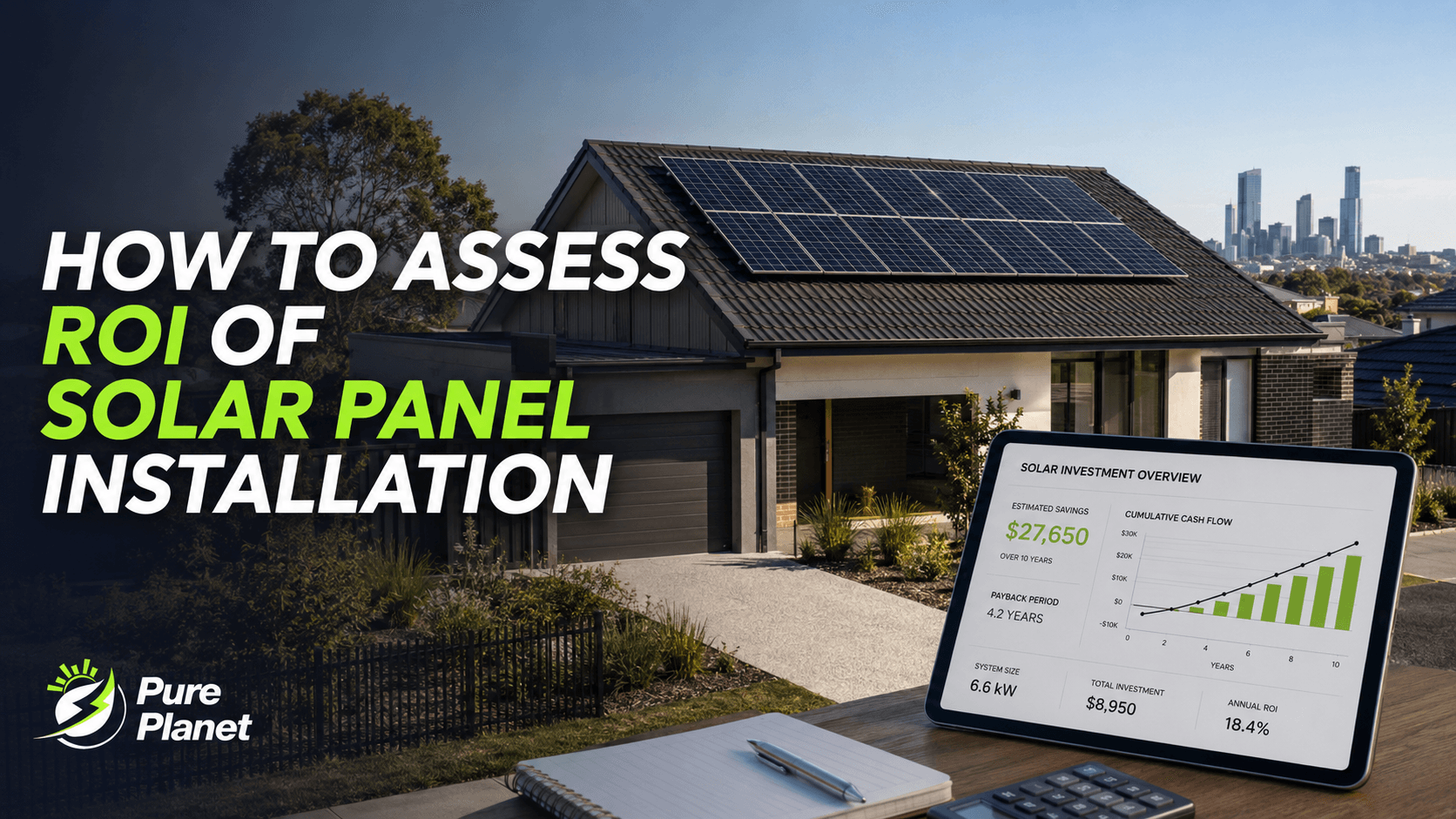
Installing solar panels is one of the biggest home investments an Australian household makes and it's also one of the most financially rewarding. But knowing exactly how rewarding requires more than a rough guess. This guide walks through the ROI calculation step by step: what solar actually costs after rebates, what it saves each year, how long until it pays for itself, and what the return looks like over a full 25-year lifespan.
Table of Contents
- 1.What ROI Means for Solar — and Why It Matters
- 2.Step 1: Work Out the True Net Cost After Rebates
- 3.Step 2: Calculate Your Annual Solar Savings
- 4.Step 3: Work Out Your Payback Period
- 5.What Factors Affect Your Solar ROI?
- 6.Solar ROI by System Size: A Quick Comparison
- 7.What Happens to Your Return After the Payback Period?
- 8.How Rising Electricity Prices Make Your ROI Even Stronger
- 9.Property Value: The ROI Factor Most Homeowners Overlook
- 10.How Adding a Battery Changes the Numbers
- 11.Conclusion
What ROI Means for Solar — and Why It Matters
ROI (Return on Investment) in solar terms is the total financial gain you receive over the life of the system compared to what you paid for it. For most Victorian households, the ROI on a quality solar installation is between 400% and 700% over 25 years far outperforming most savings accounts or term deposits.
It's not just about saving on your electricity bill. Solar ROI includes three distinct streams:
Bill savings — the electricity you no longer buy from the grid (worth 28–45 cents per kWh avoided)
Feed-in tariff credits — the surplus electricity you export back (worth 4–8 cents per kWh)
Property value uplift — the increase in your home's market value that solar adds at resale
Most ROI calculations focus only on the bill savings, which undersells the full return. When you factor in all three, the case for solar becomes even stronger.
Step 1: Work Out the True Net Cost After Rebates
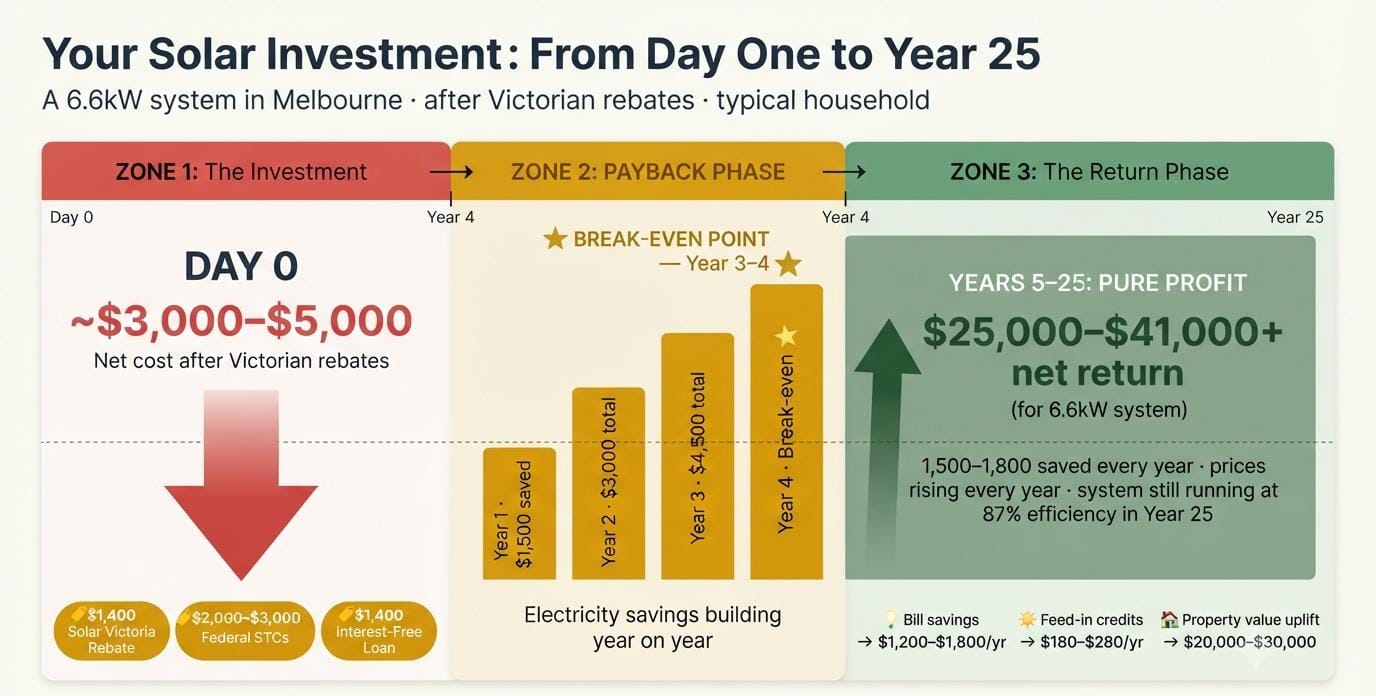
The net cost is what you actually pay after all government rebates and incentives are deducted from the upfront installation price. For most Victorian homeowners in 2026, government support reduces the net cost by $4,000–$6,000 significantly shortening the payback period.
Here's how the rebates stack up:
Solar Victoria Rebate — up to $1,400 applied directly off your invoice at point of sale
Federal STCs (Small-scale Technology Certificates) — a point-of-sale discount worth $2,000–$3,000 depending on system size and location
Interest-free loan — up to $1,400 repaid at $29.17/month over 4 years (no interest charged)
Pure Planet applies all of these directly to your quote you don't wait for a rebate cheque. To understand your specific entitlements, our guide on how solar rebates work and who can claim them covers eligibility in full.
Net cost example for a 6.6kW system: Gross system cost: ~$7,500 → minus $1,400 rebate + $2,800 STCs = net cost ~$3,300
That's the figure your ROI calculation should be based on not the sticker price.
Step 2: Calculate Your Annual Solar Savings
Your annual solar savings come from two sources: the value of electricity your panels produce that you use directly (avoided cost at your tariff rate), and the credits from any surplus you export. The avoided cost is roughly 7–10 times more valuable per kWh than the export credit.
The formula:
Annual savings = (Self-consumed kWh × your tariff rate) + (Exported kWh × feed-in tariff)
In practical terms for a Melbourne household:
A 6.6kW system generates approximately 9,000–10,000 kWh per year in Melbourne's climate
If 60% is self-consumed at 30–32 cents/kWh → ~$1,620–$1,920 saved
If 40% is exported at 5–7 cents/kWh → ~$180–$280 in credits
Total: approximately $1,800–$2,200/year for a typical household
The key lever is self-consumption. Every kWh you use from your own panels instead of the grid saves you 30–45 cents. Every kWh you export earns just 5–7 cents. Shifting heavy appliances dishwasher, washing machine, pool pump to solar hours directly improves your annual return. For a full breakdown of how to calculate savings for your specific household, see our guide on how to calculate energy savings from solar panels.
Step 3: Work Out Your Payback Period
Your payback period is simply your net system cost divided by your annual savings. For most Victorian households in 2026, this works out to 3–5 years, depending on system size, self-consumption habits, and energy tariff.
The formula:
Payback period = Net system cost ÷ Annual savings
Example: Net cost of $4,500 ÷ annual savings of $1,600 = 2.8 years
Once the payback period is reached, every cent the system saves you from that point forward is pure financial return for the remaining 20–22 years of the system's life.
What Factors Affect Your Solar ROI?
No two homes generate exactly the same return from solar. Several factors influence how quickly your system pays for itself and how much it saves over its lifetime.
Roof orientation: North-facing roofs generally produce the highest annual output, while east- and west-facing roofs can still deliver excellent returns when matched to your household's energy use.
Electricity usage: Homes that use more power during the day benefit from greater self-consumption, increasing annual savings.
System size: A system that closely matches your energy needs usually delivers the best return. Oversized systems may export more electricity, which earns a lower feed-in tariff.
Panel quality: High-quality Tier 1 panels typically maintain better performance over 25 years, improving long-term ROI.
Shading: Trees, chimneys, and nearby buildings can reduce energy production if not considered during system design.
Solar ROI by System Size: A Quick Comparison
The table below uses typical Melbourne conditions (4.5 peak sun hours/day), a standard energy tariff of 30 cents/kWh, and Victorian rebates applied. These are indicative figures your exact numbers depend on your roof, usage habits, and tariff. Use the Pure Planet savings calculator for a household-specific estimate.
What Happens to Your Return After the Payback Period?
Once your solar system has paid for itself, every dollar it saves you from that point is net profit. Over the typical 25-year lifespan of a quality solar system, a Melbourne household with a 6.6kW system can realistically accumulate $25,000–$38,000 in total net returns above the initial investment.
This is what separates solar from most home improvements. A new kitchen adds aesthetic value but doesn't generate income. Solar generates measurable, quantifiable financial returns every single day reliably, for 25 years.
Quality Tier-1 panels like those from Jinko Solar and Canadian Solar are backed by 25–30 year performance warranties and degrade at just 0.5% per year. A well-installed solar system from Pure Planet will still be producing at around 87% of original capacity in year 25.
How Rising Electricity Prices Make Your ROI Even Stronger
Every time electricity prices rise, the value of the power your solar panels generate increases automatically improving your ROI without you doing anything. Victorian electricity prices have risen 10–15% per year in recent years, and this trend is expected to continue as gas prices stay elevated and infrastructure costs increase.
To illustrate: if your panels currently save you 30 cents/kWh and electricity prices rise to 38 cents/kWh over five years, the same panels that saved you $1,500/year in year one are now saving you $1,900/year with no change to the system.
This is the compounding effect of solar. A fixed asset protecting you against a rising cost. When you calculate your 25-year ROI, using a conservative annual electricity price increase of 5–8% produces significantly higher returns than using today's flat rate.
Property Value: The ROI Factor Most Homeowners Overlook
A quality solar installation adds an estimated $20,000–$30,000 to the market value of an Australian home. This immediate uplift in property value is part of your total ROI, and it's realised the moment the system is installed, not after years of savings.
Research consistently shows Australian buyers will pay more for homes with solar already installed. A home with a functioning solar system and battery commands a premium because the new owner inherits years of bill savings from day one. For more on this, our article on how residential solar systems affect property value breaks down the data behind those figures.
If your ROI calculation includes a reasonable property value uplift, the effective payback period for many systems drops below two years.
How Adding a Battery Changes the Numbers
Adding a home battery to your solar installation improves annual savings by capturing surplus daytime production for use in the evening, reducing your grid import to near zero. For most Melbourne households, this adds $400–$800/year in additional savings but also adds to the upfront cost, extending the combined payback period slightly.
Without a battery: excess daytime solar exports at 5–7 cents/kWh. With a battery: that same surplus is stored and used at night, replacing grid power worth 30–45 cents/kWh. The difference in value per kWh is enormous.
The ROI case for a battery is strongest when:
Your electricity tariff has a high peak rate (above 30 cents/kWh)
Your household uses significant power in the evening (after 5pm)
You are interested in full energy independence or blackout protection
The NeoVolt and Fox ESS home batteries Pure Planet installs are specifically designed for this pattern, with 10-year warranties and 10,000+ cycle ratings that ensure the battery outlasts its payback period comfortably.
💡 Pro Tip
When comparing solar quotes, ask each installer for the projected annual energy production (kWh), expected annual savings, and estimated payback period not just the installation price. Comparing long-term returns instead of upfront costs gives a far more accurate picture of value.
Conclusion
Understanding your solar ROI is about more than calculating a payback period. It helps you choose the right system size, estimate long-term savings, and make a confident investment based on real numbers rather than assumptions.
With government rebates, rising electricity prices, and quality solar systems lasting 25 years or more, many Australian homeowners recover their investment within a few years and continue saving for decades. The key is choosing a system designed around your property's energy needs.
If you're considering solar, Pure Planet can provide a personalised assessment, estimate your expected savings, explain available rebates, and recommend the system that delivers the best long-term return for your home.
Request a free quote and savings estimate and we'll give you the full ROI picture for your specific home, roof, and usage profile.