A straight-talking guide for Melbourne homeowners weighing up a solar battery: what it does day to day, current pricing, the rebate most people haven't heard about yet, realistic lifespan, and how to size one properly instead of guessing.
Table of Contents
- 1.What Does a Solar Battery Actually Do for Your Home?
- 2.How Much Does a Solar Battery Cost in 2026?
- 3.Why the Federal Rebate Is Worth Knowing About
- 4.How Long Does a Solar Battery Actually Last?
- 5.How to Choose the Right Size for Your Household
- 6.Why Batteries and Heat Pumps Work So Well Together
- 7.Is a Solar Battery Actually Worth It for You?
- 8.The Bottom Line
More than 220,000 Australian households added a solar battery in 2025. That's not a marketing statistic, it's a sign that the maths finally started working in homeowners' favour, largely thanks to a federal rebate most people still don't know exists.
If you're weighing up whether a battery is worth adding to your solar system, or wondering if it's still too expensive to bother with, this guide walks through what actually matters: what the battery does, what it costs after rebates, how long it holds up, and how to know if your household will get real value out of one.
What Does a Solar Battery Actually Do for Your Home?
Put simply, a solar battery catches the power your panels produce during the day that your household isn't using at that moment, and holds it for later. Without one, that surplus gets exported to the grid for a feed-in credit that's shrunk considerably over the past few years. With one, you can use that same power once the sun's gone down, run appliances overnight, or keep essential circuits running through a blackout if your system is configured for backup.
That's the everyday version. For the technical side of how the charge and discharge cycle works, our home battery systems explainer goes into more depth than this guide needs to. Pure Planet installs home battery systems from three brands, NeoVolt, Fox ESS, and GoodWe, each with a slightly different fit depending on your home and how much backup you want.
How Much Does a Solar Battery Cost in 2026?
Price comes down to three things: capacity, brand, and whether your current inverter can already talk to a battery or needs upgrading. Here's roughly where things sit for a fully installed system, before any rebate:
NeoVolt's modular range and Fox ESS's EP and EQ series both sit comfortably in these bands, while GoodWe's Lynx systems suit households after a higher-voltage, plug-and-play setup. None of these numbers matter much, though, until you know your actual usage pattern, which is what the sizing section below is for.
Why the Federal Rebate Is Worth Knowing About
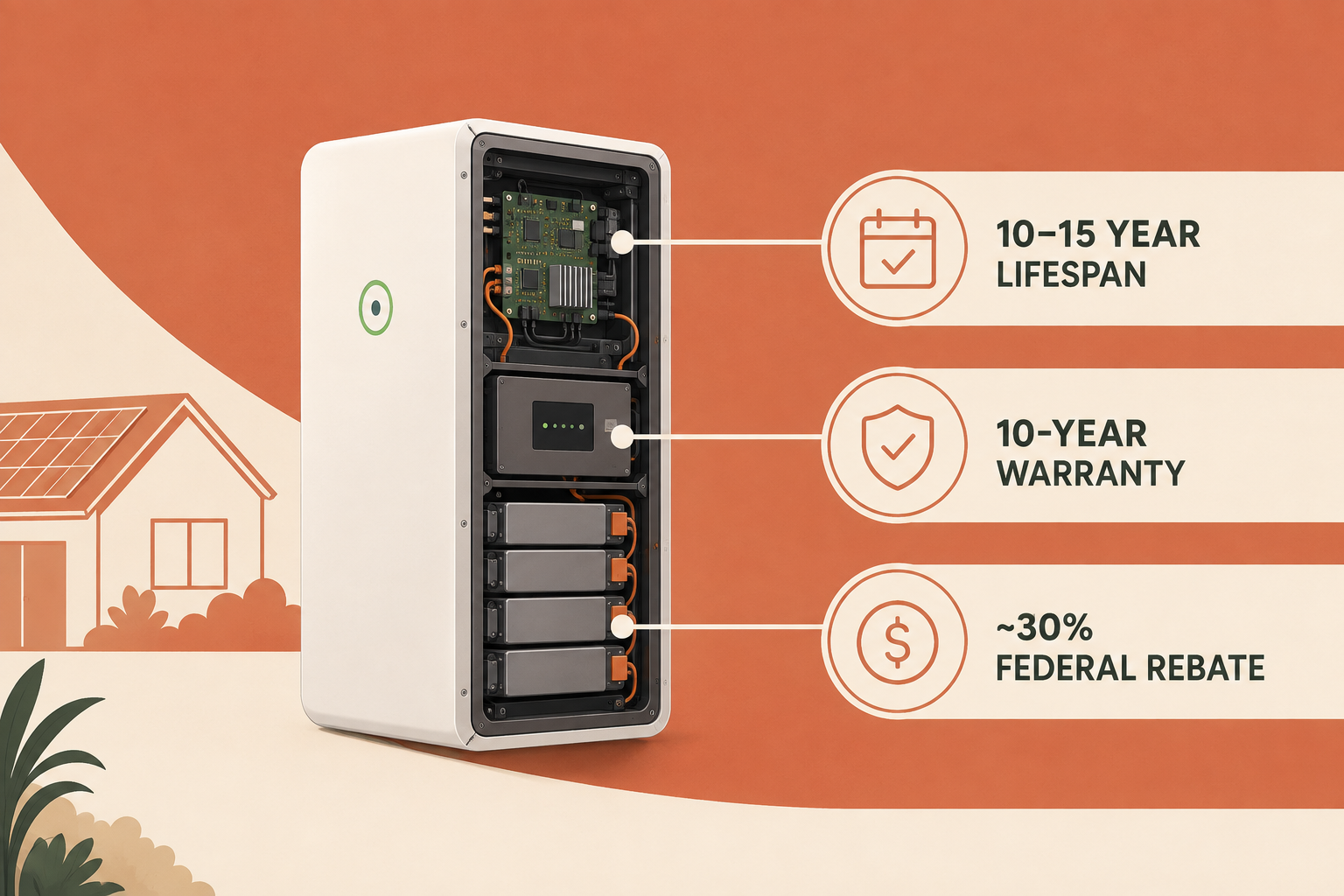
Since 1 July 2025, the Cheaper Home Batteries Program has been funding roughly 30% off eligible battery systems between 5kWh and 100kWh. It runs through the same Small-scale Renewable Energy Scheme that already discounts solar panels, and your installer applies it upfront at the point of sale. There's no separate form to lodge and no waiting on a reimbursement.
It's also separate from Victoria's own solar incentives, and the two can often be used together depending on your setup. Our guide to how solar rebates work covers the Victorian side in detail. Because eligibility and the current rebate level shift over time, we confirm the exact figure for your household as part of your quote rather than promising a fixed number here.
How Long Does a Solar Battery Actually Last?
Most batteries on the market today, including everything in the NeoVolt, Fox ESS, and GoodWe ranges, use lithium iron phosphate (LFP) cells rated for 10 to 15 years of everyday use, backed by a 10-year manufacturer warranty.
On payback, a battery costing around $6,000 after the federal rebate generally pays for itself in 2.7 to 4.7 years for a home that already has solar. Households with heavier evening usage, steeper peak tariffs, or a bigger existing solar system tend to land toward the faster end of that range.
How to Choose the Right Size for Your Household
A bigger battery isn't automatically a better one. If you install more capacity than your evening usage ever draws on, you're paying for storage that sits idle most nights. Getting the size right comes down to three things: how much electricity your household actually uses after sunset, how much solar you're generating during the day to recharge it with, and how many hours of backup you actually want if the power goes out.
We've broken this down properly in a separate guide. How solar batteries improve nighttime energy usage walks through sizing a battery against a real household's hour-by-hour load, which is the only reliable way to get this right.
Why Batteries and Heat Pumps Work So Well Together
If your hot water still runs on gas, or on an old electric system that only heats on off-peak, pairing a heat pump with a solar battery is one of the better combinations available to Victorian homeowners right now. A heat pump's flexible running hours mean it can draw mostly on stored solar rather than grid power, even well after dark. Our post on solar batteries and heat pumps covers exactly how the two work together.
Is a Solar Battery Actually Worth It for You?
A battery earns its keep fastest when a few things line up:
- Your feed-in tariff is low compared to what you pay for grid electricity in the evening
- Your household genuinely uses power after dark, cooking, heating, running appliances
- Blackouts or an unreliable grid connection are a real concern where you live
- Your solar system already produces more than your household uses during the day
If most of your electricity use happens while the sun's up, your existing solar system is likely already doing the heavy lifting, and a battery may add less value than you'd expect.
💡 Pro Tip
Before you decide on battery size, pull your last three months of electricity bills and check your actual evening usage in kWh, not just your daily total. That's the number that determines your payback period, not the raw capacity on the price list. A battery sized within a kWh or two of your real overnight draw will outperform a bigger, more expensive one that's mostly sitting half-empty every night.
The Bottom Line
Home batteries have gotten a lot harder to ignore in the past year. A federal rebate that didn't exist before mid-2025, paired with feed-in tariffs that keep dropping, has changed the payback maths for a lot of Melbourne households that wrote batteries off as too expensive a year or two ago. The households getting the best results aren't necessarily buying the biggest system. They're the ones who've matched the battery to how their home actually uses power after dark, rather than picking a number and hoping.
You don't have to work out the sizing or rebate stacking on your own. Try our solar and battery calculator for a quick estimate, or get a free battery quote and we'll size a system around how your household actually runs.