A practical look at what commercial solar actually costs in Melbourne right now, by system size, what pushes a quote up or down, how current incentives reduce the upfront number, and the extra line items businesses tend to overlook until they see the final invoice.
Table of Contents
- 1.Why Commercial Solar Pricing Isn't a Single Number
- 2.What Does Commercial Solar Actually Cost by System Size?
- 3.What Drives Your Total Price Up or Down?
- 4.How Much Do Incentives Actually Reduce the Upfront Cost?
- 5.The Extra Costs Businesses Often Miss
- 6.How Do You Compare Commercial Solar Quotes Properly?
- 7.Is Commercial Solar Worth the Investment in Melbourne?
- 8.Conclusion
Ask three different installers what a commercial solar system costs and you'll likely get three different answers, and none of them will be wrong. A 30kW system and a 200kW system aren't the same purchase scaled up, they're different projects with different cost structures, which is exactly why a single "commercial solar costs $X" headline figure is close to useless for actually budgeting your own installation.
Here's what businesses in Melbourne are genuinely paying in 2026, broken down by system size, what moves that number, and where the current incentives actually land.
Why Commercial Solar Pricing Isn't a Single Number
Residential solar pricing is fairly standardised because most homes fall into a handful of common system sizes. Commercial sites don't work that way. A retail shopfront, a 24-hour cold storage warehouse, and a multi-building industrial site can all technically be "commercial solar," but they call for entirely different system designs, roof work, and electrical upgrades. If you're still getting your head around how business installations differ from a household system, our guide on key differences between home and business solar systems is a useful starting point before you get quotes.
What Does Commercial Solar Actually Cost by System Size?
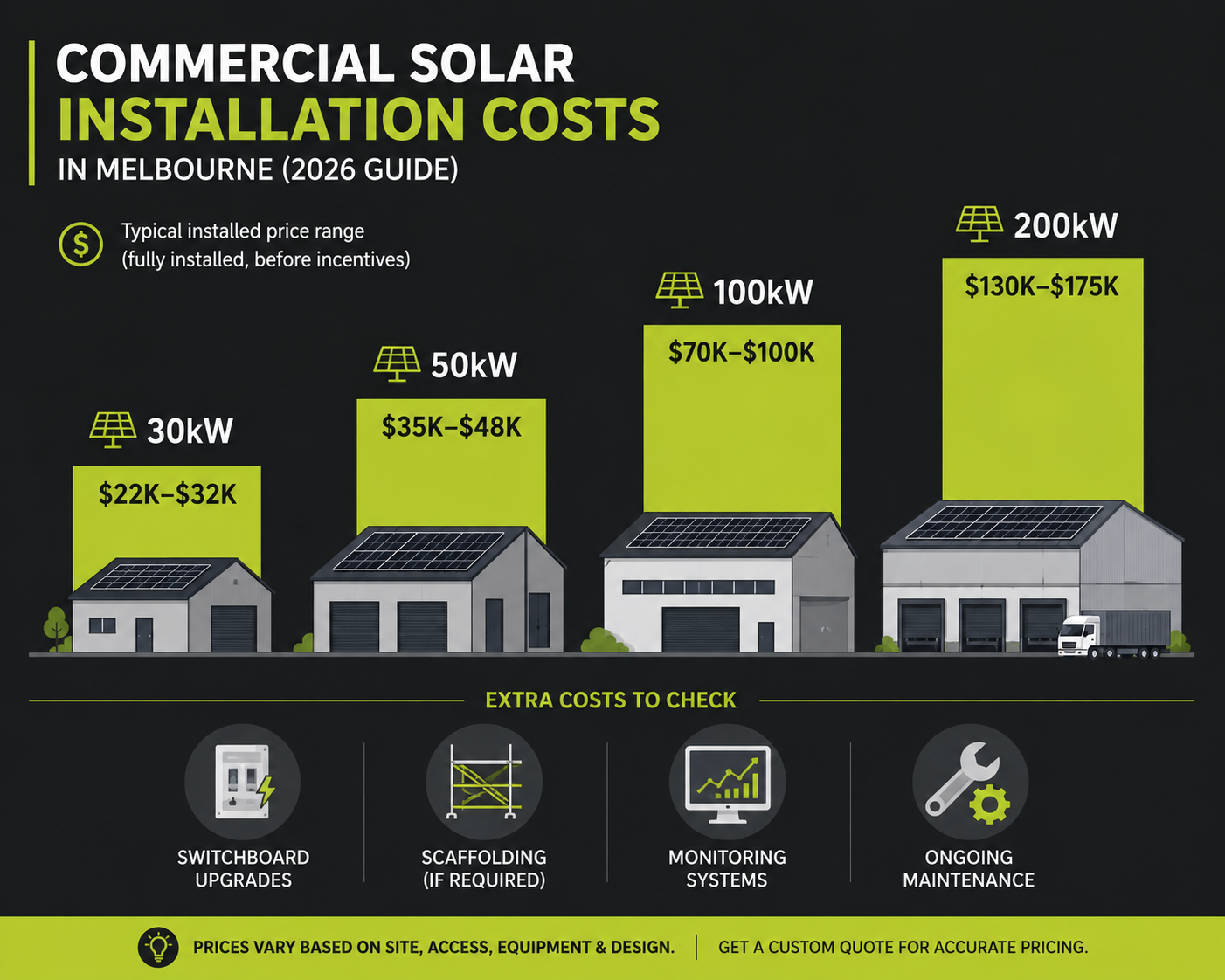
Based on current industry pricing across the commercial solar market, here's roughly where a fully installed system tends to land before any incentives are applied. Treat these as indicative ranges, not a quote, since your actual price depends heavily on your specific site.
The per-kilowatt rate typically drops as system size increases, since design and mobilisation costs get spread across more panels. That said, larger systems often carry more site-specific electrical work, which can offset some of that saving.
💡 Pro Tip
When two quotes for a similar-sized system come back with a large price gap, ask both installers for a like-for-like breakdown of equipment tier, switchboard work, and warranty length before assuming one is simply cheaper. A lower headline number that excludes a needed switchboard upgrade isn't actually the cheaper quote once the missing item gets added back in.
What Drives Your Total Price Up or Down?
A handful of factors explain most of the difference between two quotes for a similarly sized system:
- Roof type and access. A straightforward metal-deck warehouse roof installs faster and cheaper than a complex, multi-level, or heritage-constrained roof.
- Equipment tier. Premium Tier-1 panels and commercial-grade inverters generally cost more upfront but come with stronger warranties and better long-term output.
- Electrical capacity at the site. Older commercial buildings sometimes need a switchboard or three-phase upgrade before a system can even be connected.
- Grid export limits. Your electricity distributor may cap how much you can export, which affects system design and sometimes requires additional equipment to manage.
- Structural assessment. Older industrial roofs occasionally need an engineering check before installation, particularly for larger arrays.
How Much Do Incentives Actually Reduce the Upfront Cost?
Two mechanisms currently apply, and which one kicks in depends on your system size. Systems up to 100kW generally qualify for Small-scale Technology Certificates (STCs), a federal discount built into your quote at the point of sale rather than claimed afterward, worth roughly $2,800 for a 10kW system and scaling up from there. Separately, Victoria's own Commercial and Industrial Solar PV discount, delivered through the Victorian Energy Upgrades program, applies to systems between 30kW and 200kW.
We've written a full breakdown of exactly how these stack, what's confirmed versus still pending, and who qualifies in commercial solar rebates Victoria: business incentives, since the incentive side of this deserves more detail than a pricing guide has room for. The short version: expect the combined effect of current incentives to meaningfully reduce your net cost, but the exact figure depends on your system size and current certificate pricing, which moves month to month.
The Extra Costs Businesses Often Miss
The headline installed price rarely tells the whole story. Costs that catch businesses off guard include:
- Switchboard or three-phase upgrades, if your existing electrical infrastructure can't support the new system
- Scaffolding or elevated work platform hire for taller industrial buildings where standard access isn't possible
- Monitoring software subscriptions, which some installers include and others charge separately
- Ongoing maintenance and cleaning, particularly relevant for sites near dust, agriculture, or coastal air
- Inverter replacement, typically needed once during a system's lifespan, generally somewhere in year 10 to 15
- Insurance updates, since adding a significant asset to your roof is worth confirming with your business insurer
None of these are hidden fees exactly, but they're easy to miss if a quote only shows the headline installed price.
How Do You Compare Commercial Solar Quotes Properly?
A lower number on paper isn't automatically the better deal. Before comparing two quotes side by side, check that both cover the same ground:
- Confirm whether the quoted price already has any applicable incentive built in, or whether that's calculated separately
- Check the panel and inverter brand and tier, not just the total system size in kW
- Ask specifically whether switchboard work, scaffolding, and monitoring are included or additional
- Compare warranty length and what it actually covers, not just the headline years
- Confirm the installer's accreditation for both standard CEC installation and the Victorian Energy Upgrades commercial activity, since one doesn't guarantee the other
Our page on commercial solar panel installation outlines what's included in a Pure Planet quote by default, which is a useful benchmark to measure any other quote against.
Is Commercial Solar Worth the Investment in Melbourne?
For most businesses with meaningful daytime electricity use, yes, though the payback period varies with system size, usage pattern, and how much of the current incentives apply to your installation. Beyond the upfront cost, an appropriately sized system also reduces peak demand charges, the fee your network applies based on your highest burst of usage in a billing period. Our guide on how commercial solar systems save businesses money goes into the ongoing savings side of this in more depth than a pricing guide needs to.
Conclusion
Commercial solar pricing in Melbourne isn't a single figure you can quote from memory, it moves with system size, site conditions, and which incentives currently apply. What matters most isn't chasing the lowest headline number, it's understanding exactly what that number includes and comparing quotes on the same terms. Businesses that get the best outcome are the ones asking for an itemised breakdown upfront, not the ones discovering the extra costs after signing.
If you want an accurate, site-specific number rather than an industry estimate, get a free commercial solar quote and we'll size a system against your actual roof, usage, and budget before you commit to anything.