Smart batteries don't just store energy, they manage it. By pairing a home battery with intelligent scheduling, solar integration, and time-of-use settings, Melbourne homeowners can cut their electricity bills significantly and rely on the grid far less. This guide covers exactly how to get the most out of your battery storage system, from choosing the right hardware to setting it up for maximum daily savings
Table of Contents
- 1.What Makes a Battery "Smart"?
- 2.Smart Battery vs Standard Battery
- 3.How Smart Batteries Work With Solar Panels
- 4.Time-of-Use Scheduling and Why It Matters
- 5.Key Specs That Affect Performance
- 6.Depth of Discharge (DoD)
- 7.Round-Trip Efficiency
- 8.Cycle Life
- 9.Government Rebates for Battery Storage in Australia
- 10.Residential vs Commercial Battery Optimisation
- 11.Residential Optimisation
- 12.Commercial Optimisation
- 13.Is a Smart Battery Worth It for Your Home?
- 14.Practical Tips for Getting the Most From Your Battery
- 15.Conclusion
Optimizing energy storage with smart batteries means programming your system to charge when electricity is cheapest or solar production is highest, then discharge when grid power costs the most. Done correctly, this single strategy can cut a Melbourne household's evening electricity bill close to zero. Most homeowners never configure this and end up paying far more than they need to.
A standard battery stores power. A smart battery manages power. The difference shows up directly on your electricity bill each quarter. Understanding how to set yours up correctly is the fastest way to see a real return on your investment.
What Makes a Battery "Smart"?
Not all home batteries operate the same way. A smart battery system includes software intelligence that goes beyond simple storage. It monitors your solar production in real time, reads your household consumption patterns, and adjusts how it charges and discharges throughout the day , automatically.
The batteries Pure Planet installs, including the NeoVolt and Fox ESS range, come with dedicated monitoring apps and smart energy management built in. You can view your live energy flow, set charge and discharge windows, and receive alerts all from your phone.
Key features that define a smart battery:
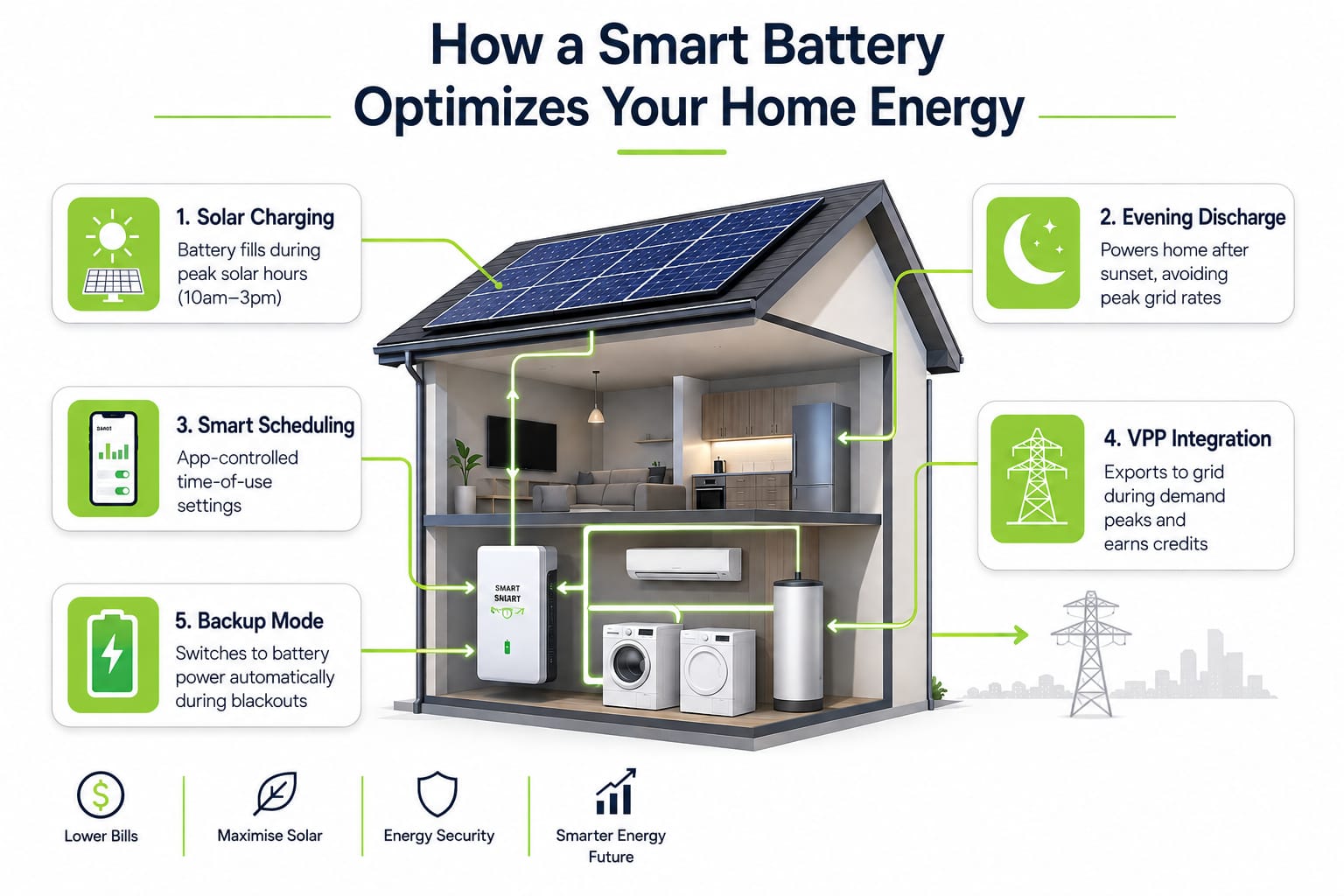
- Real-time solar monitoring — the battery communicates with your inverter to prioritise solar charging before drawing from the grid
- Time-of-use (TOU) scheduling — set specific hours for charging and discharging based on your energy tariff
- Virtual Power Plant (VPP) compatibility — opt into programs where your battery supports the grid during peak demand and earns credits
- Emergency backup mode — automatically switches to battery power during a blackout without any manual intervention
Comparison Table
Smart Battery vs Standard Battery
How Smart Batteries Work With Solar Panels
During daylight hours, your solar panels produce more electricity than your household typically uses. Without a battery, that surplus flows back to the grid at a low feed-in tariff, often as little as 3–5 cents per kilowatt-hour.
With a smart battery in place, that surplus is captured and stored instead. When the sun goes down and your household consumption increases, the battery releases the stored power meaning you avoid buying back electricity at 30–40 cents per kilowatt-hour from the grid.
The smarter the battery, the more precisely it can manage this cycle. A well-configured system from Pure Planet's home battery service will automatically detect when your panels are producing more than you need and begin charging with no manual input required.
Time-of-Use Scheduling and Why It Matters
Most Victorian energy retailers now offer time-of-use (TOU) tariffs. Under these plans, electricity is cheaper at certain times of day (off-peak) and significantly more expensive during evening peak hours, typically 3:00 PM to 9:00 PM.
Smart batteries allow you to schedule your system around these windows:
- Charge during off-peak hours (e.g., late night or midday solar) when electricity is cheapest
- Discharge during peak hours (e.g., evening) when grid power is most expensive
- Avoid peak grid draw entirely by relying on stored power for cooking, heating, and appliance use after sunset
This one scheduling adjustment can save a Melbourne household an additional $300–$600 per year on top of standard solar savings. To see how this compares to running a gas-based home, our gas vs electric savings guide breaks down the full financial picture.
Key Specs That Affect Performance
Getting the most out of your battery starts with understanding what the numbers on the spec sheet actually mean for your daily energy use.
Depth of Discharge (DoD)
DoD tells you how much of the battery's total capacity you can safely use. A 10kWh battery with a 95% DoD gives you 9.5kWh of usable storage. Always check this figure it tells you the real-world energy available, not just the headline number.
Round-Trip Efficiency
This is the percentage of energy you get back out of the battery compared to what you put in. The NeoVolt delivers 97.8% round-trip efficiency, meaning almost no energy is wasted during the charge-discharge cycle. Lower-quality batteries can lose 10–15% in this process.
Cycle Life
Every charge and discharge counts as one cycle. The NeoVolt is rated for 8,000+ cycles , meaning it will last well over 20 years under normal household use. Fox ESS batteries are similarly rated for long-term residential and commercial applications. For a detailed comparison of how inverters and batteries work together, see our guide on solar inverters and batteries.
Government Rebates for Battery Storage in Australia
Battery storage in Victoria is supported by several financial incentives that reduce the upfront cost significantly.
- Solar Victoria Interest-Free Loan — up to $1,400 applied directly off the cost of your battery system, repaid at $29.17 per month over four years
- VEU Credits — Victorian Energy Upgrades program provides certificates that translate to $600–$1,200+ in savings on eligible installations
- Federal STCs — Small-scale Technology Certificates reduce the cost of eligible systems at the point of sale
Pure Planet manages all rebate paperwork and applies the savings directly to your quote. You don't wait for a check , the discount is immediate. To check your eligibility, use our rebate calculator.
Residential vs Commercial Battery Optimisation
The fundamentals of smart battery management are the same whether you're running a family home or a commercial premises but the scale and strategy differ.
Residential Optimisation
For a household, the priority is covering the evening peak. A 9.6kWh to 13kWh battery, charged by a 6.6kW to 10kW solar array, is typically sufficient to power an average Melbourne home through the night without drawing from the grid.
Commercial Optimisation
For businesses, smart batteries address an additional cost demand charge. Energy retailers charge commercial customers based on their highest 30-minute energy draw of the month. By discharging battery power during periods of peak business activity, you flatten that spike and avoid the penalty. A 30kW–100kW commercial solar system paired with a GoodWe Lynx C or Fox ESS EQ commercial battery can be cash-flow positive from the first month of operation.
Is a Smart Battery Worth It for Your Home?
Many homeowners wonder whether adding a smart battery is worth the extra investment. The answer depends on your electricity usage, solar generation, and energy goals. If you already have solar panels, a smart battery allows you to store excess electricity during the day and use it during expensive evening peak periods instead of buying power from the grid. Homes with higher evening energy consumption often see the greatest financial benefit.
Beyond reducing electricity bills, smart batteries provide greater energy independence and can supply backup power during outages, depending on the system you choose. When combined with available rebates and intelligent energy management, they can deliver long-term savings while helping households make better use of renewable energy.
💡 Pro Tip
Set your battery's minimum state of charge to 20% rather than 0%. Running a lithium battery completely flat repeatedly shortens its lifespan. By keeping a floor, you protect your investment and always have reserve power available for unexpected appliance loads in the late evening. Most smart battery apps including the Neo Volt and Fox ESS apps allow you to set this floor with a single toggle.
Practical Tips for Getting the Most From Your Battery
No matter which battery you have installed, these habits make a measurable difference to your daily savings.
Review your tariff structure — confirm whether you're on a flat-rate or time-of-use plan, then adjust your scheduling settings accordingly. Your energy retailer's website will show current peak and off-peak windows.
Run heavy appliances during solar hours — washing machines, dishwashers, and dryers should run between 10:00 AM and 3:00 PM when your panels are producing at full capacity. This preserves battery charge for the evening.
Enable VPP if available — Pure Planet installs batteries that are compatible with Virtual Power Plant programs. Participating earns you grid export credits and contributes to Victoria's energy stability. Our blog on virtual power plants explains exactly how these programs work.
Pair with a heat pump — hot water heating is one of the largest evening energy draws in any home. Scheduling your heat pump to run during peak solar hours completely removes this load from your battery budget. Read more about how solar batteries work with heat pumps at night.
Check your app weekly — most smart batteries flag when something is off, such as lower-than-expected charge cycles or a panel underperforming. Catching these early prevents small issues from becoming costly ones.
Conclusion
Choosing the right battery is only part of the equation—optimising how it stores and delivers energy is what maximises long-term savings. By combining a smart battery with quality solar panels, the right charging schedule, and available government rebates, Australian homeowners can reduce grid reliance and make better use of every kilowatt they generate.
If you're considering battery storage or want to improve the performance of your existing system, Pure Planet can help you find the right solution for your home. Our experienced team designs customised energy systems that deliver reliable performance, lower electricity costs, and long-term value.
Pure Planet designs and installs battery systems specifically for Victorian homes and businesses, with every system sized, configured, and connected to maximise your daily savings. If you'd like to know exactly how much a battery could save your household, request a free energy assessment and we'll work through the numbers with you.