A practical walkthrough of how solar payback is actually calculated in Melbourne, the handful of numbers that genuinely move it, and why a home and a business rarely land on the same payback period even with a similarly sized system. Includes worked examples for both, clearly labelled as illustrations rather than guaranteed outcomes.
Table of Contents
- 1.What Does "Payback Period" Actually Mean?
- 2.The Five Numbers That Actually Determine Your Payback
- 3.How to Calculate Your Own Payback Period, Step by Step
- 4.Why Commercial Solar Payback Looks Different
- 5.What Can Shorten or Extend Your Payback?
- 6.Feed-in Tariffs Aren't What They Used to Be
- 7.Residential vs Commercial Payback at a Glance
- 8.Conclusion
"Solar pays for itself in X years" is one of the more repeated lines in this industry, and it's also one of the least useful, because payback period isn't a fixed number attached to a system size. It's the output of five separate variables multiplied together, and changing any one of them changes the answer. A household that's home all day and a business that operates during business hours can install an identical system and land on genuinely different payback periods.
This guide walks through how payback is actually calculated, what moves it, and why residential and commercial numbers diverge, using worked examples you can adapt with your own figures rather than borrowing someone else's headline claim.
What Does "Payback Period" Actually Mean?
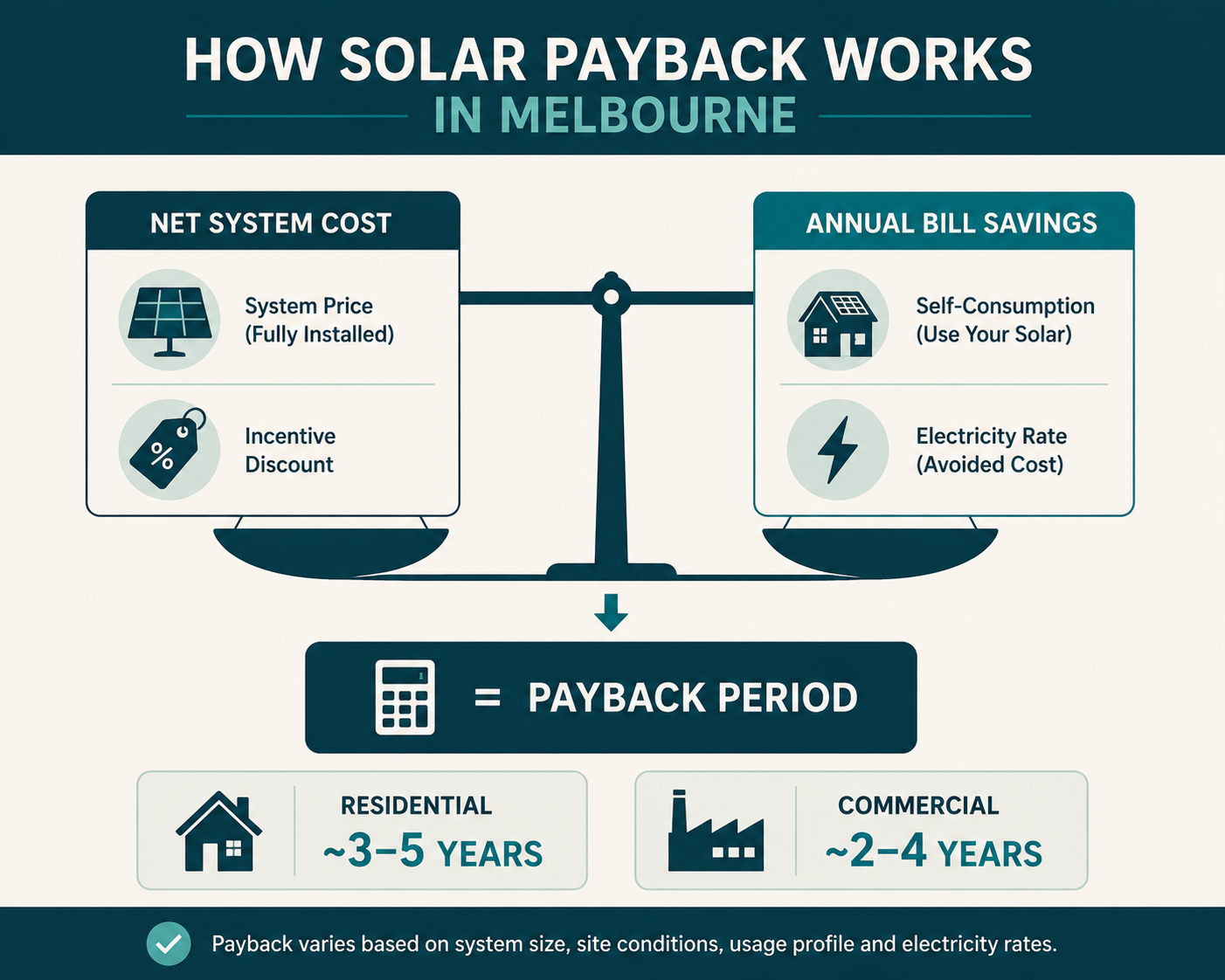
At its simplest, payback period is the answer to one question: how long until your bill savings equal what you spent on the system? The formula behind every solar payback claim is the same one:
Net system cost (after incentives) ÷ annual bill savings = payback period in years
Everything else in this guide is really about how to fill in those two numbers accurately, because a rough guess on either side produces a payback figure that looks precise but isn't.
The Five Numbers That Actually Determine Your Payback
System cost before incentives. The starting price of your installed system, which varies by size, site, and equipment.
Incentives applied. Federal Small-scale Technology Certificates (STCs) and, for eligible households, the Victorian Solar Homes rebate, both reduce your net cost before payback is even calculated.
Self-consumption rate. The percentage of your solar generation you actually use on-site, rather than exporting to the grid. This is the single most misunderstood number in most payback claims.
Electricity rate. What you'd otherwise pay per kWh for grid power, since every self-consumed kWh is a kWh you didn't buy at retail price.
Feed-in tariff. What you're paid for exported power, which matters far less than it used to (more on that below).
💡 Pro Tip
Before accepting any quoted payback figure, ask what self-consumption percentage it assumes. A quote built around 80% self-consumption for a household that's out at work all day is starting from an unrealistic number, and the payback period built on top of it will be too.
How to Calculate Your Own Payback Period, Step by Step
Here's a worked residential example using currently available Melbourne figures, clearly labelled as an illustration rather than a promise.
Take a 6.6kW system, a common size for our solar panel installations, with an installed cost of roughly $7,000 before incentives. After the federal STC discount and an eligible household's Victorian Solar Homes rebate of up to $1,400, the net cost lands around $5,000 to $5,500. Assume an average annual electricity bill of $1,600, and a solar system that offsets 70% of that bill through a mix of self-consumption and export credits, a mid-range outcome, not the top of the range. That's an annual saving of roughly $1,120.
$5,500 ÷ $1,120 ≈ 4.9 years
That lines up closely with the 3–5 year payback range typically seen for well-sized residential systems in Melbourne. Change the self-consumption assumption, the bill size, or the rebate eligibility, and this number moves accordingly, which is exactly why two households with the same system size can report different payback periods.
For a deeper, single-scenario walkthrough of residential ROI specifically, our guide on how to assess ROI of solar panel installation covers additional angles like long-term returns and property value that this guide doesn't repeat.
Why Commercial Solar Payback Looks Different
Run the same formula for a business, and the answer usually comes out faster, not slower, which surprises people expecting a bigger system to mean a longer wait.
Take a 50kW commercial system, priced around $42,000 installed before incentives (see our commercial solar cost guide for the full range by system size). The federal STC discount alone brings that down to roughly $28,500, before Victoria's separate Commercial and Industrial Solar PV discount is even factored in, which would reduce it further (our commercial solar rebates guide breaks down exactly how that stacks).
Now assume the business operates mostly during daylight hours, so it self-consumes around 70% of what the system generates rather than exporting it. At roughly 78,000kWh of annual generation and an average retail rate of 27c/kWh, that works out to an annual saving of approximately $14,450.
$28,500 ÷ $14,450 ≈ 2 years
That's a genuine, if simplified, illustration, and the real number would likely be shorter still once the VEU discount is included. The core reason commercial payback tends to beat residential payback isn't the incentives alone, it's self-consumption: a business running equipment, refrigeration, or lighting through the day uses far more of its own solar output than a household that's largely empty until evening.
What Can Shorten or Extend Your Payback?
Shortens it:
Higher self-consumption (using more of what you generate, rather than exporting it)
A higher retail electricity rate (each self-consumed kWh is worth more)
Full eligibility for available incentives
A system sized correctly against actual usage, not oversized for the roof space available
Extends it:
Low self-consumption, particularly for households often away from home during the day
A system sized larger than what your usage pattern actually supports
Missing eligibility for a rebate you assumed applied
Declining panel or inverter performance beyond the manufacturer's expected output curve
Feed-in Tariffs Aren't What They Used to Be
One detail that changes the maths more than people expect: from 1 July 2025, the Essential Services Commission stopped setting a minimum feed-in tariff in Victoria altogether. Retailers now set their own rate, and it can legally sit anywhere from a few cents down to zero. The average minimum rate across retailers for the current financial year sits under one cent per kilowatt-hour.
What this means practically is that exporting surplus solar to the grid is no longer a meaningful part of most payback calculations, self-consumption is. A system sized to match your actual daytime usage, so more of its output gets used on-site rather than exported, will consistently outperform a larger system that exports more than it needs to.
Residential vs Commercial Payback at a Glance
These ranges are illustrative, not a guarantee for any specific property or business.
Conclusion
Payback period isn't a number you can borrow from someone else's system, it's a calculation built from your own cost, incentives, usage pattern, and how much of your solar you actually use versus export. The households and businesses getting the most accurate picture aren't the ones chasing the shortest headline figure; they're the ones running the calculation against their real electricity bill and usage pattern, not an assumed one.
If you want that calculation done properly for your own home or business, get a free solar quote and we'll size a system against your actual usage rather than a generic assumption.