
A financial guide to solar batteries in Melbourne: what they actually cost once every line item is accounted for, which incentives genuinely apply in 2026 (and which have closed), how to work out realistic savings, and how to calculate your own payback period instead of relying on someone else's headline number.
Table of Contents
- 1.How Much Does a Solar Battery Cost in Melbourne?
- 2.What Rebates or Incentives Are Available for Solar Batteries in Melbourne in 2026?
- 3.How Much Can a Solar Battery Save in Melbourne?
- 4.How to Calculate Solar Battery Payback
- 5.What Affects Solar Battery Payback in Melbourne?
- 6.Solar Panels vs Solar + Battery: Which Makes More Financial Sense?
- 7.Who Is Most Likely to Benefit From a Solar Battery?
- 8.What Should You Check Before Buying a Solar Battery?
- 9.How to Compare Solar Battery Quotes
- 10.Is a Solar Battery Worth It in Melbourne in 2026?
- 11.Conclusion
How Much Does a Solar Battery Cost in Melbourne?
Battery pricing isn't just about capacity in kWh. A fully installed price reflects several separate line items, and quotes for the same battery size can vary substantially depending on:
Battery capacity versus usable capacity. A battery's advertised capacity and what you can actually draw on day to day aren't always the same number, since most batteries reserve a margin to protect battery life.
Brand and model. Established brands with strong local support and longer track records typically cost more than newer or lesser-known imports.
Inverter compatibility. If your existing solar inverter can't communicate with a battery, you may need a hybrid inverter upgrade, which adds meaningfully to the total cost.
Backup power requirements. A battery configured to keep circuits running during a blackout needs additional switching equipment beyond a standard grid-connected setup.
Switchboard and electrical work. Older switchboards sometimes need upgrading before a battery can be safely connected.
Installation complexity, including wall mounting, cabling runs, and site access.
Warranty length and product quality, since a longer, more comprehensive warranty is generally priced into the equipment cost.
As a general, current indication rather than a fixed PurePlanet quote, batteries in the 10kWh range tend to sit somewhere in the $8,000 to $12,000 mark installed, with 13kWh and larger systems moving higher depending on the factors above. Pure Planet's home battery systems page outlines the specific brands and models available if you want to see what's on offer locally. Treat any number here as a starting point for your own research, not a substitute for a written quote.
💡 Pro Tip
Ask your installer for your household's actual evening and overnight electricity usage in kWh, not an estimate, before choosing a battery size. Most solar monitoring apps or your retailer's smart meter data can show this. Buying a battery larger than your real overnight draw is the single most common reason people end up disappointed with their payback period.
What Rebates or Incentives Are Available for Solar Batteries in Melbourne in 2026?
This is the section where outdated information causes the most confusion, so it's worth being precise. Different types of financial support work in genuinely different ways:
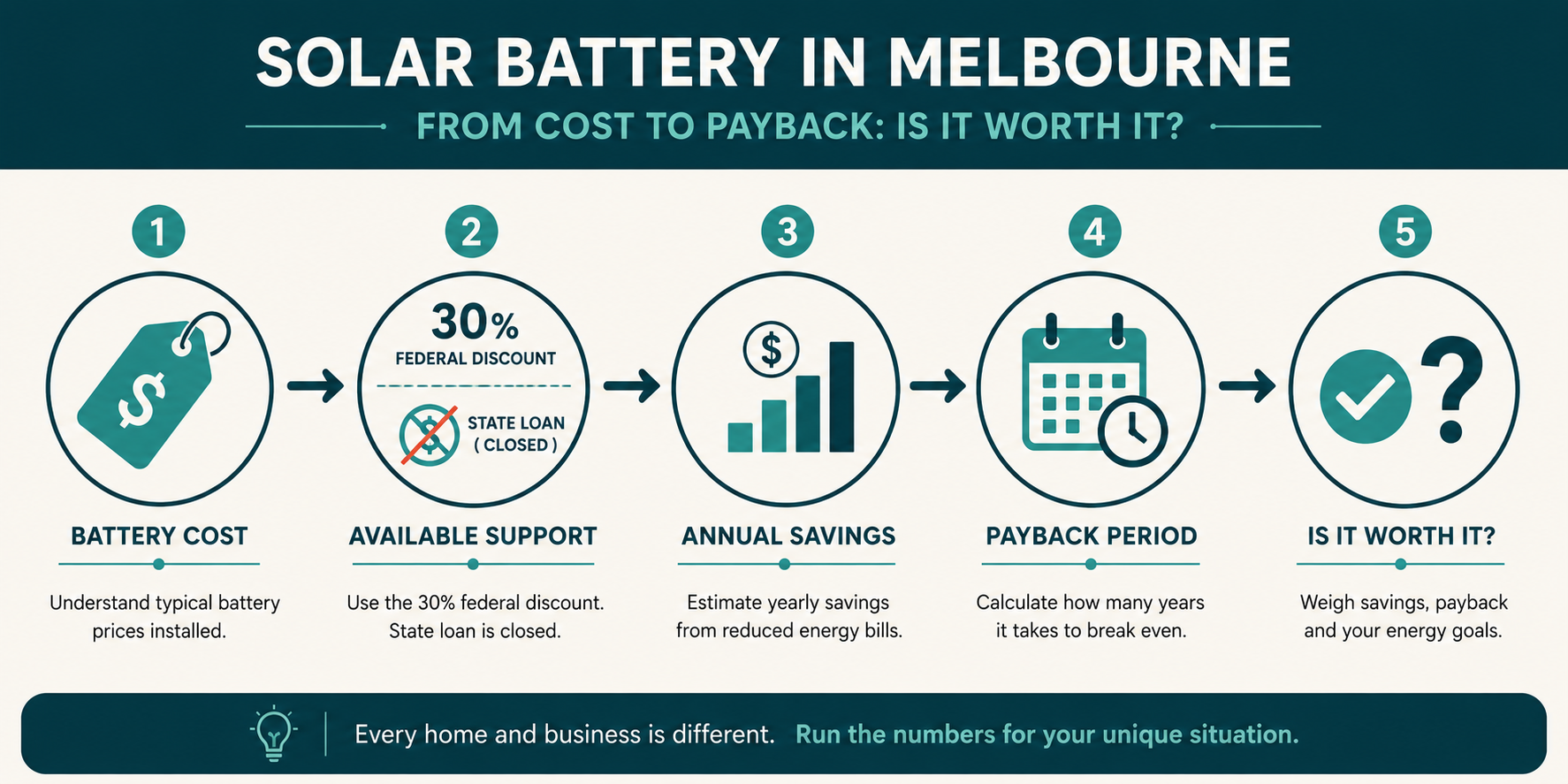
The practical takeaway: if you're budgeting for a battery in 2026, the federal 30% discount is the incentive to factor in, not a state battery loan that no longer exists.
How Much Can a Solar Battery Save in Melbourne?
The savings mechanism is straightforward in concept: daytime solar you're not using gets stored in the battery, then discharged in the evening or overnight instead of you buying that electricity from the grid. What determines the actual dollar value is less straightforward, and depends on:
How much surplus solar your system generates during the day beyond what your household uses in real time
How much electricity your household actually uses in the evening and overnight
Your battery's usable capacity and round-trip efficiency, since some energy is lost in the charge and discharge process
Your retail electricity rate, since every kWh drawn from the battery instead of the grid is worth whatever you'd otherwise pay for it
Your feed-in tariff, since a lower export rate makes storing power for personal use comparatively more valuable than exporting it
Two households with an identical battery can see meaningfully different savings if one uses most of its evening electricity on a heat pump and cooking while the other is largely out of the house until late. There's no single percentage that applies to every home, and treating a battery's savings potential as a fixed number is how expectations end up mismatched with reality. Our guide on how solar batteries improve nighttime energy usage goes deeper into sizing a battery against your actual overnight load if you want to work through this in more detail.
How to Calculate Solar Battery Payback
The formula behind every battery payback claim is:
Net battery cost (after incentives) ÷ annual battery savings = payback period in years
Net cost means the installed price minus the federal discount, not the sticker price. Annual savings means the actual value of grid electricity you avoid buying by using stored solar instead, not a generic industry percentage.
Here's a simple, clearly labelled example, not a guarantee. Take a 10kWh battery installed for approximately $10,000. After the federal Cheaper Home Batteries Program discount of roughly 30%, the net cost lands around $7,000. If the household discharges an average of 6kWh a day from stored solar instead of buying it from the grid, at a retail rate of around 27c/kWh, that's an annual saving of roughly $591.
$7,000 ÷ $591 ≈ 11.8 years
For a household with heavier evening usage, discharging closer to the full 10kWh most nights, the same net cost divided by an annual saving of roughly $985 comes out closer to 7 years. Both are illustrations built from stated assumptions, and your own figure will land somewhere based on your actual usage, not either of these examples specifically.
What Affects Solar Battery Payback in Melbourne?
A number of variables move the payback calculation, which is why two Melbourne homes can land on very different numbers with the same battery:
Battery cost and capacity, since a larger battery costs more but doesn't always generate proportionally more savings
Household electricity usage, particularly the split between daytime and evening consumption
Existing solar system size and generation, since a battery can only store surplus that your panels actually produce
Electricity prices, which determine how valuable each avoided grid kWh is
Feed-in tariffs, since a very low export rate makes self-consumption comparatively more valuable
Battery efficiency and degradation, since usable capacity and performance decline gradually over the battery's lifespan
Installation costs, including any switchboard or inverter work specific to your home
Warranty terms, which affect the real-world lifespan you should calculate payback against
Future electricity prices, since rising rates would improve payback on a system already installed, though this isn't something to bank on in the calculation itself
Solar Panels vs Solar + Battery: Which Makes More Financial Sense?
Solar panels and batteries solve different problems. Panels reduce how much electricity you buy from the grid by generating your own during the day. A battery doesn't generate anything, it stores solar you've already generated so you can use it later instead of exporting it for a low feed-in rate.
For a household that uses most of its electricity during the day, solar panels alone often capture most of the available saving, and a battery adds cost without much additional benefit. For a household with significant evening or overnight usage and solar that regularly exceeds daytime consumption, a battery can meaningfully increase how much of that generation actually gets used rather than exported for very little. Neither is universally the better choice; it depends on when your household actually uses electricity.
Who Is Most Likely to Benefit From a Solar Battery?
A battery tends to make the strongest financial case for households that:
Use a meaningful share of their electricity after sunset, for cooking, heating, or appliances
Already generate more solar during the day than they use in real time
Have an existing solar system large enough to reliably charge a battery, not just a small legacy system
Want to increase how much of their own solar they use rather than export
Value backup power during outages as a genuine priority, separate from the financial case alone
A battery is less likely to deliver a strong financial return for a household that's largely home and using power during the day already, since there's less surplus solar left over to store, or for a household whose existing solar system is small relative to its overall usage.
What Should You Check Before Buying a Solar Battery?
Usable battery capacity, not just the advertised total
Warranty length and what it actually covers
Expected cycle life, and how that translates to real years of use
Round-trip efficiency
Inverter compatibility with your existing solar system
Total installation cost, including any switchboard or wiring work
Backup power capability, if that matters to your household
Monitoring, and whether it's included or a separate subscription
Options to expand capacity later if your usage grows
Installer experience and accreditation
Total installed cost after any current incentive
Realistic expected annual savings based on your own usage
An estimated payback period built from your own numbers, not a generic claim
How to Compare Solar Battery Quotes
The cheapest quote isn't automatically the best value once everything is accounted for. When comparing quotes side by side, check:
The total installed price, not just the battery unit cost
Battery capacity versus usable capacity, since these numbers can be presented inconsistently between installers
Which inverter is included or required, and whether it's compatible with your existing solar
What electrical work is included versus billed as an extra
Warranty terms on both the battery and the installation itself
Whether backup functionality is included or optional
What monitoring is provided
Expected performance and efficiency figures for the specific model quoted
What after-sales support looks like if something needs servicing
Getting more than one quote is worth the time, since two installers pricing the same battery model can differ significantly once installation, backup configuration, and warranty terms are all accounted for.
Is a Solar Battery Worth It in Melbourne in 2026?
The honest answer is that it depends on your own numbers, not a general rule. A battery is more likely to be worth it if your upfront cost after the federal discount is reasonable relative to your usage, your household draws a meaningful amount of power in the evening or overnight, your existing solar system generates enough surplus to charge it reliably, and you've calculated a payback period you're genuinely comfortable with, not just seen a headline figure from an unrelated household.
If those numbers line up, a battery can be a sound financial decision. If your household uses most of its electricity during the day already, or your existing solar system is small, the honest answer might be that a battery isn't the best next step for your finances specifically, even if it remains attractive for backup power or energy independence reasons unrelated to payback.
Conclusion
A solar battery's value in Melbourne comes down to arithmetic specific to your own home, not a number borrowed from an advertisement or a neighbour's system. Work out your net cost after the current federal incentive, your realistic annual savings based on your actual evening usage, and the payback period that comes from dividing one by the other, and you'll have a genuinely useful answer instead of a guess.
If you'd like that calculation done properly against your own electricity usage and existing solar system, request a personalised solar and battery assessment and we'll work through the real numbers with you before you commit to anything.