Not sure whether solar panels or wind energy is the better investment for your property? This guide compares both renewable energy options based on installation costs, energy production, maintenance, efficiency, government incentives, and long-term savings. You'll learn why solar is the preferred choice for most Australian homes, when wind energy may be suitable, and the key factors to consider before making your decision. By the end, you'll have a clear understanding of which renewable energy solution best fits your location, budget, and energy needs.
Table of Contents
- 1.What is Solar Energy and How Does it Work?
- 2.Cost Savings and Electricity Bill Reduction
- 3.Factors Affecting Efficiency: Sun vs. Wind
- 4.Government Rebates and Incentives in Australia
- 5.Residential vs Commercial Solar Use
- 6.Residential Renewable Choice
- 7.Commercial Renewable Choice
- 8.Practical Tips for Choosing the Right System
- 9.Frequently Asked Questions
- 10.How much can solar panels save in Australia?
- 11.Are solar panels worth it in Australia?
- 12.What rebates are available for solar systems?
- 13.Is wind energy better than solar at night?
- 14.Can I have both solar and wind?
- 15.Conclusion
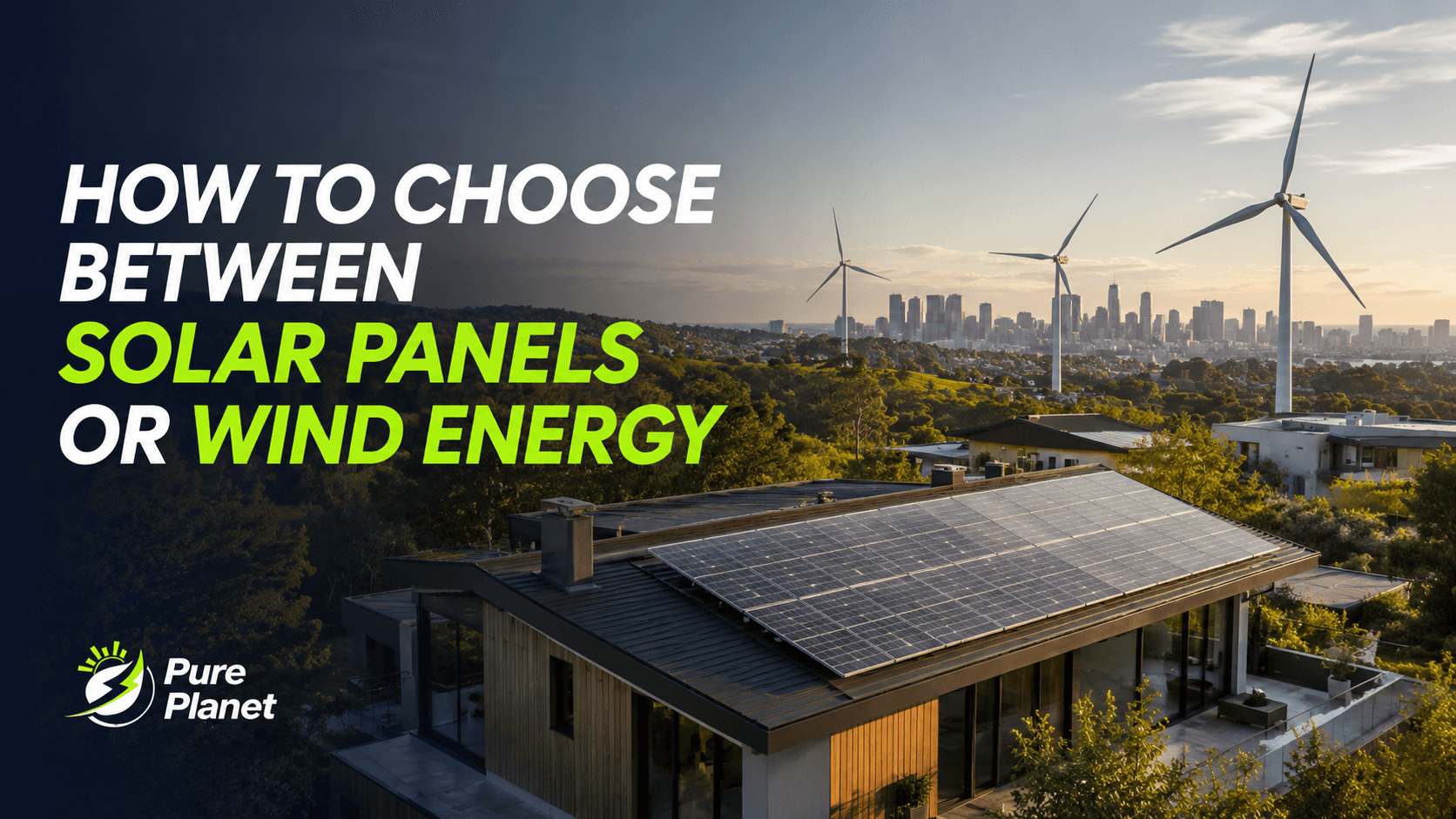
Choosing between solar panels or wind energy depends largely on your location, available space, and local climate. For the vast majority of Australian homeowners, solar panels are the superior choice due to lower installation costs, minimal maintenance, and high reliability in our sun-drenched environment. While wind turbines can generate power at night, they require specific wind speeds and zoning approvals that make them less practical for suburban residential areas.
In Australian households, solar systems typically offer a much faster return on investment and are supported by robust government incentives. A properly installed solar system can provide a consistent and predictable energy yield, whereas small-scale wind turbines are often subject to turbulent air and mechanical wear. Most homeowners notice reduced electricity bills immediately after installing solar, making it the go-to solution for sustainable living in 2026.
What is Solar Energy and How Does it Work?
Solar energy is a renewable energy source that converts sunlight into electricity using solar panels, helping households and businesses reduce reliance on grid power. When sunlight hits the photovoltaic (PV) cells within the solar panels, it creates direct current (DC) electricity. This energy is then sent to inverter systems, which transform it into alternating current (AC) for use in your home or business.
Wind energy, on the other hand, uses the kinetic energy of moving air to turn turbine blades, which spins a generator to create power. While wind is a powerful part of renewable energy Australia wide at a utility scale, it faces significant hurdles at a residential level, such as noise restrictions and the need for high, unobstructed towers to catch consistent breezes.
Cost Savings and Electricity Bill Reduction
The financial goal of any renewable installation is a significant electricity bill reduction. Solar excels here because it aligns with the peak energy needs of many households, particularly during the day when air conditioners and appliances are in high use.
Most homeowners notice reduced electricity bills when they utilize solar to cover their daytime "baseload" and export surplus power through their grid connection to earn feed-in tariffs. Wind energy can theoretically provide night-time savings, but the high upfront cost of a residential turbine often means the "payback period" is significantly longer than that of a solar array. You can explore our solar panel installation options to see how modern high-efficiency panels provide the best financial outcome for urban and rural homes alike.
Factors Affecting Efficiency: Sun vs. Wind
Efficiency is the measure of how much natural resource is converted into usable power. Both systems are highly dependent on their environment.
Solar Efficiency: Modern panels now reach over 22% efficiency. They work best with a North-facing roof and minimal shading. Even on cloudy days, they still produce a measurable amount of power.
Wind Efficiency: A small turbine requires a consistent wind speed (usually above 12 km/h) to even start spinning. In suburban areas, houses and trees create "turbulence," which drastically reduces a turbine's lifespan and output.
Maintenance Needs: Solar panels have no moving parts and require only occasional cleaning. Wind turbines have bearings, blades, and gearboxes that require regular mechanical servicing to prevent failure.
For more information on maximizing the performance of a home power plant, check out our latest solar blog posts where we discuss the importance of orientation and system sizing.
Government Rebates and Incentives in Australia
The Australian government heavily favors solar through various solar rebates and incentives. The Small-scale Technology Certificate (STC) scheme provides a direct upfront discount on the purchase price of a solar system, often saving homeowners thousands of dollars.
While some incentives exist for small-scale wind, they are often harder to access and require more complex compliance checks. Solar, being a mature technology in the Australian market, has a streamlined application process. In 2026, many states also offer interest-free loans specifically for solar battery storage, allowing you to store your daytime solar harvest for use at night—effectively doing the job a wind turbine would do, but with far greater reliability.
Residential vs Commercial Solar Use
The decision between solar panels or wind energy often shifts when looking at large-scale commercial operations.
Residential Renewable Choice
For a standard home, solar is almost always the winner. It is quiet, aesthetically pleasing, and fits on existing roof structures. It integrates perfectly with the modern Australian lifestyle, particularly for those working from home or using electric vehicles.
Commercial Renewable Choice
For large rural businesses or farms with vast open acreage, a hybrid approach might be considered. However, even for large factories, commercial solar systems remain the primary choice because warehouse roofs provide the perfect "dead space" for massive solar arrays. Businesses prioritize the low maintenance and guaranteed production levels that solar provides to satisfy their financial forecasting.
Practical Tips for Choosing the Right System
If you are struggling to decide between solar panels or wind energy, consider these three practical steps before making an investment.
Check Local Zoning: Most Australian councils have strict height and noise regulations that may prohibit residential wind turbines. Solar rarely requires a planning permit for standard homes.
Assess Your Resource: Use a solar map or wind speed tool to see which resource is more abundant at your specific address. Most of Australia is "solar-rich."
Think Long-Term: Consider the total cost of ownership over 20 years. Solar panels are typically warranted for 25 years, whereas small wind turbines often have much shorter warranties due to their moving parts.
To ensure you get the best technology for your property, you can speak with our accredited solar installers who can provide a site-specific generation report.
💡 Pro Tip
Don't choose based on technology alone, choose based on your property's conditions. Before investing, have a professional site assessment completed to evaluate your roof orientation, shading, available space, and local wind conditions. In most Australian locations, this assessment confirms that a well-designed solar system delivers greater energy production, lower maintenance costs, and a faster return on investment than a residential wind turbine.
Frequently Asked Questions
How much can solar panels save in Australia?
In Australia, a 6.6kW solar system can save a household between $1,500 and $2,200 per year on average. Savings are even higher if you have a battery to offset peak evening rates.
Are solar panels worth it in Australia?
Yes. Australia has some of the highest electricity prices and the best solar resources in the world. With current rebates, most systems pay for themselves in 3 to 5 years.
What rebates are available for solar systems?
The federal STC scheme provides an upfront discount. Many states also offer additional rebates, interest-free loans, or feed-in tariffs for renewable energy Australia wide.
Is wind energy better than solar at night?
While wind turbines can spin at night, they are often inconsistent. A better solution for night-time power in Australia is usually solar battery storage, which stores the guaranteed energy produced by your panels during the day.
Can I have both solar and wind?
Yes, this is called a hybrid system. It is sometimes used in off-grid rural locations, but for most grid-connected homes, the extra cost of the wind turbine and its specialized inverter is rarely justified by the energy produced.
Conclusion
When choosing between solar panels or wind energy, the evidence for Australian properties is clear. Solar panels offer a more affordable, reliable, and low-maintenance path to energy independence. While wind energy plays a vital role in our national grid, it remains a difficult and often inefficient option for individual home use. By investing in a high-quality solar system paired with battery storage, you can achieve 24/7 renewable power that is backed by strong warranties and government support.
Understanding how solar energy works and the savings it offers can help you make a more informed decision when considering a solar system for your property.