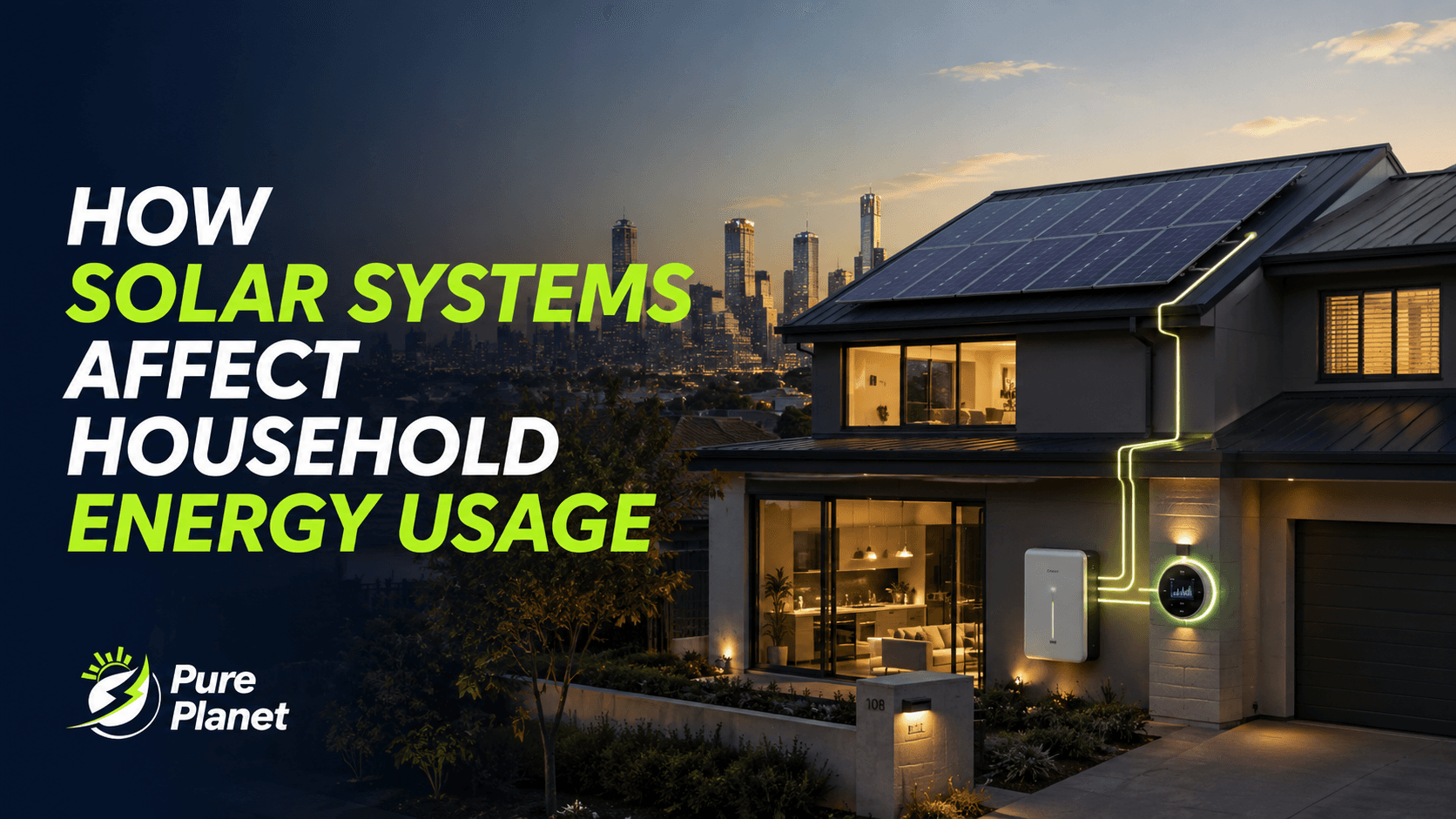
Going solar doesn't just generate clean energy it changes how your entire household interacts with electricity. From scheduling appliances around the sun to storing power for the evening, solar ownership is as much about how you use energy as it is about how much you save.
Table of Contents
- 1.What Changes When You Go Solar?
- 2.Before vs After Solar: A Side-by-Side Comparison
- 3.Simple Changes That Maximise Your Solar Savings
- 4.Why Load Shifting Saves You More Money
- 5.Which Appliances Benefit Most from Daytime Solar
- 6.How Solar Makes More Electric Appliances Affordable
- 7.How Monitoring Apps Change the Way You Think About Energy
- 8.How Much Grid Dependency Can You Realistically Cut?
- 9.Common Mistakes New Solar Owners Make
- 10.Conclusion
What Changes When You Go Solar?
When you install solar panels, your home gains a free daytime energy source. The immediate effect is that electricity generated on your roof powers your appliances first, before any grid power is drawn. This changes the economics of when you run certain appliances and once you understand that shift, you can save considerably more than the system's base performance alone.
Before solar, most households used energy passively, appliances run when convenient, bills arrive quarterly, and there's no particular reason to think about what time you're consuming power. After solar, the time of day you run certain appliances directly affects how much you pay. Energy produced between roughly 9am and 4pm is yours for free. Energy drawn from the grid in the evening costs money. That one distinction drives almost every behavioural change that follows.
For a closer look at the financial side of these savings, see our guide on how solar panels reduce household electricity bills.
Before vs After Solar: A Side-by-Side Comparison
Before solar, households draw all electricity from the grid at full retail rates, regardless of time. After solar, daytime usage is largely self-powered, evening usage can be covered by a battery, and the grid becomes a backup rather than the primary source.
Simple Changes That Maximise Your Solar Savings
Installing solar doesn't mean changing your lifestyle completely. Small adjustments are often enough to get better value from your system.
Here are a few easy habits that can increase your savings:
- Run your dishwasher, washing machine, and dryer during the middle of the day.
- Charge electric vehicles during solar production hours whenever possible.
- Schedule your heat pump or electric hot water system to run between 10am and 2pm.
- Use timers for appliances that don't need to run immediately.
- Check your monitoring app occasionally to understand your energy usage.
Why Load Shifting Saves You More Money
Load shifting means moving high-energy appliances to run during daylight hours when your solar system is producing. Done consistently, it's the single most effective way to increase self-consumption and get more value from your system without spending anything extra.
Think of it this way: if your washing machine, dishwasher, and pool pump all run at 8pm, you're paying grid rates for all three. Shift those to 10am–2pm when solar output is at its peak and you run them for free. The energy is already being generated; if nothing's consuming it, it either exports to the grid for a small credit, or goes to waste.
Simple load-shifting moves that cost nothing:
- Set your dishwasher on a delay timer to start at 10am
- Run the washing machine straight after morning school drop-off
- Set pool pump cycles to run from 10am–3pm
- Programme your hot water heat pump to heat between 10am and 2pm
- Pre-cool or pre-heat your home while solar is producing, before evening peak
These small schedule adjustments can increase your self-consumption rate from around 30% to 60% or more which effectively doubles the value you get from each kilowatt-hour your system produces.
Which Appliances Benefit Most from Daytime Solar
The appliances that use the most electricity give you the biggest savings when timed to solar hours. Washing machines, dryers, dishwashers, pool pumps, air conditioning, and electric hot water systems are all ideal candidates for daytime scheduling.
Here's a practical guide to common household appliances and their solar savings opportunity:
- Air conditioning (2–4 kW) — running it during peak solar hours in summer means a Melbourne heatwave costs nothing during the day
- Washing machine and dryer (2–3 kW combined) — two or three loads shifted to solar hours saves several dollars a day in a high-usage household
- Pool pump (0.75–1.5 kW) — runs for hours; keeping it within the solar window can save $300–$500 per year on its own
- Dishwasher (1–2 kW) — easy to shift using the machine's built-in delay-start timer
- Oven and cooking (2–3.5 kW) — harder to shift, but even one lunchtime cooking session reduces evening grid draw
The goal isn't to rearrange your life around the sun. It's to move the tasks that already need doing into the hours when your solar panels are generating freely.
How Battery Storage Transforms Evening Energy Use
Without a battery, solar only helps during daylight hours. A home battery stores surplus daytime solar generation and releases it in the evening extending your solar system's benefit through the night, when grid rates are typically highest.
Most Victorian households consume 40–50% of their daily energy after 5pm. Without a battery, that entire block of evening usage comes from the grid. With a battery, it can come almost entirely from solar energy generated during the day stored and waiting.
A well-matched home battery (10–13.5 kWh for a medium-sized household) covers most evening loads: lighting, cooking, TV, phone charging, and standby power overnight. When the battery is drained, the grid takes over but by then, you've already avoided the most expensive consumption window.
Adding a battery typically increases solar self-consumption from around 30–40% (panels only) to 80–90%, turning your daytime generation into near round-the-clock energy independence.
How Solar Makes More Electric Appliances Affordable
Solar doesn't just reduce the cost of running your existing appliances it makes entirely new, high-consumption appliances practical and affordable. Electric vehicle charging, heat pump hot water systems, and ducted reverse-cycle air conditioning all become economical when powered by your own generation.
Electric vehicles are the most impactful example. A standard EV uses roughly 15–20 kWh per 100km. Charging at full grid rates costs $4–6 per session. Charging from your own solar generation during the day costs nothing. Households with a driveway EV charger and a solar system often find their transport fuel costs drop to near zero.
Heat pump hot water systems are a natural match for solar. They run most efficiently in the middle of the day and can be programmed to heat within your peak solar window. A heat pump uses approximately 1–1.5 kWh to produce the same hot water that a standard electric element needs 3.6 kWh to heat. When that 1–1.5 kWh comes from your roof, your hot water is essentially free. If you're considering the switch, our heat pump hot water page covers the models Pure Planet installs across Victoria.
Ducted air conditioning previously one of the most expensive things to run in a Melbourne home becomes far more manageable when solar covers the bulk of daytime summer consumption. Pre-cooling before 5pm, while panels are still producing, avoids the grid entirely during the highest-rate hours.
How Monitoring Apps Change the Way You Think About Energy
Most modern solar systems include a monitoring app that displays real-time generation, household consumption, battery state, and grid import/export in one place. Once energy becomes visible, most homeowners naturally start making smarter decisions without being told to.
Before solar, energy is abstract. You use the lights, and a bill arrives. After solar, you can see that your roof generated 22 kWh today, you consumed 14 kWh, exported 8 kWh to the grid, and your battery is at 82%. That visibility changes behaviour in ways that are hard to predict in advance.
Habits solar owners commonly develop after using monitoring apps:
- Switching off standby appliances they hadn't realised were drawing power
- Timing appliance use around peak generation windows shown in the app
- Spotting energy-hungry devices often old fridges or wine coolers they hadn't previously noticed
- Checking battery state before deciding whether to run the air conditioner in the evening
- Recognising seasonal patterns and adjusting their routine in winter when output drops
These small shifts compound over time and often add hundreds of dollars to annual savings beyond what the system would produce on autopilot.
For more on how solar savings work in practice, revisit our breakdown of how solar panels reduce household electricity bills.
How Much Grid Dependency Can You Realistically Cut?
A typical Melbourne household without solar imports 100% of its electricity from the grid. After adding solar panels, that drops to roughly 50–60%. Add a battery, and grid dependency typically falls further to 10–30% depending on system size, household consumption, and daily habits.
These figures assume average Melbourne conditions (4.5–5 peak sun hours per day), a 6.6–10kW system, and typical household behaviour. Higher self-consumption through load shifting improves these numbers further.
Reaching near-zero grid dependency is achievable for many Victorian households but it requires the right system size, a battery, and some attention to when major appliances run. Use our solar savings calculator to see what's realistic for your specific home, roof, and energy profile.
💡 Pro Tip
Set a reminder on your phone for the first weekend of each season to check your monitoring app's monthly export figure. If exports are consistently above 30–40% of total generation, you have room to shift more appliances into solar hours and you're effectively leaving free energy on the table. Each season's sun pattern is different: summer gives you more midday power, winter gives you less. A small scheduling adjustment each quarter keeps your self-consumption optimised year-round without any ongoing effort.
Common Mistakes New Solar Owners Make
Many households install solar but continue using electricity exactly as they did before. As a result, they export more electricity than necessary and miss opportunities to reduce their bills.
Some common mistakes include:
- Running high-energy appliances late in the evening.
- Forgetting to use appliance timers.
- Ignoring the monitoring app.
- Choosing a battery before understanding actual energy usage.
- Assuming every solar system performs the same regardless of roof orientation or shading.
Conclusion
Going solar changes your household's relationship with energy in ways that go well beyond bill savings. It makes you aware of when power is being produced, encourages smarter appliance scheduling, enables new electric loads like heat pumps and EV chargers, and with a battery extends your energy independence through the night.
The households that see the biggest results are the ones that take a few simple steps: run the dishwasher at 10am instead of 10pm, set the heat pump to heat during solar hours, check the monitoring app occasionally, and adjust appliance schedules to match the sun's pattern. None of it requires ongoing effort once it's set up and the savings build every single day.
Ready to see how solar could change the way your home uses energy? Three ways to get started:
📞 Call us: 0450 010 419
🌐 Visit: pureplanet.net.au
📋 Get a personalised assessment: Request a free quote