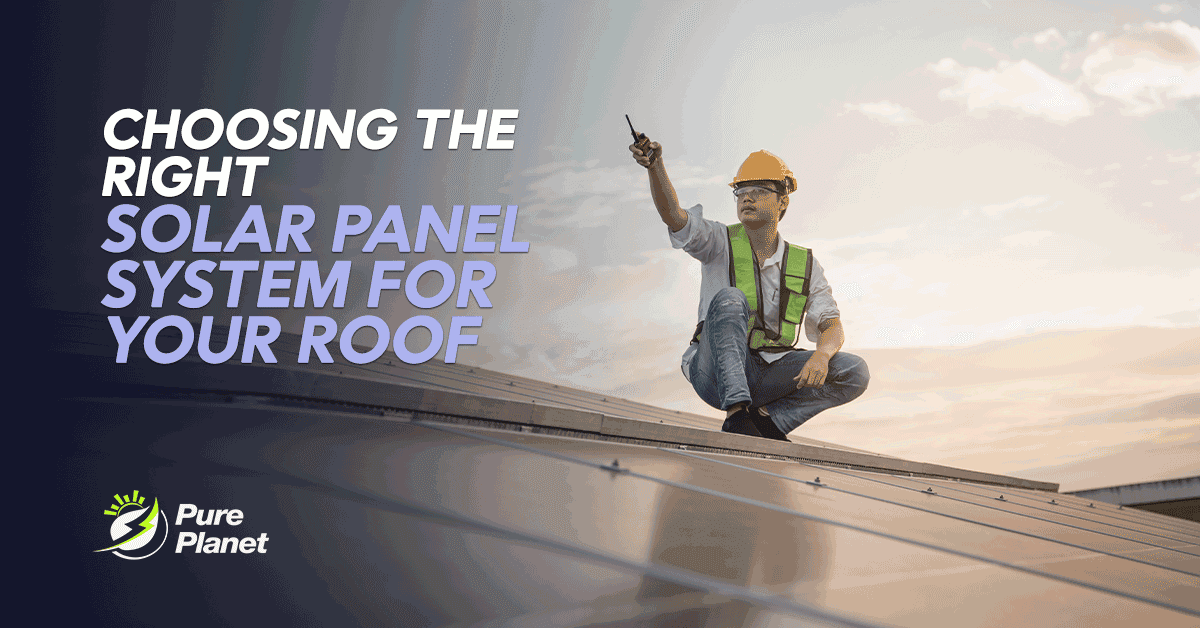
Learn how to choose the right solar panel system for your roof type. From Colorbond to tile, discover the best layout and panel technology for your Melbourne home.
Table of Contents
Every Australian home is unique, and the "perfect" solar system depends heavily on the specific characteristics of your rooftop. When planning an installation, you must consider more than just the number of panels; you need to account for the material, the available area, and the structural orientation of your home. Selecting a system that is tailored to your roof ensures maximum energy yield and prevents long-term structural issues.
At Pure Planet, we specialise in custom-engineered solar solutions for a wide variety of Victorian roof types. Our goal is to match the latest N-type panel technology with your specific architecture to create a high-performance energy ecosystem that lasts for decades.
Assessing Your Roof Material and Mounting Needs
The material of your roof is the first factor that determines how your solar system will be physically attached. In Melbourne, the two most common types are metal (Colorbond) and tiled roofs. Metal roofs are often considered the "gold standard" for solar because they are lightweight and allow for a very flexible installation. Mounts can be attached directly to the structural ribs, often without the need for piercing the metal, which maintains superior waterproofing.
![Close up of solar panels being mounted on a Colorbond metal roof]
Tiled roofs, whether terracotta or concrete, require a more delicate approach. Installers must carefully lift individual tiles to secure "tile hooks" to the rafters underneath. While this process is highly effective, it requires precision to ensure no tiles are cracked during the installation. High-efficiency monocrystalline panels are typically recommended for tiled roofs as they provide the best power-to-weight ratio, putting less stress on the overall structure.
Matching System Size to Available Space
The physical size of your roof will naturally limit the total capacity of your solar array. In 2026, standard residential panels typically measure around 1.7m x 1.1m and produce between 420W and 460W. If you have a smaller roof, you should opt for high-efficiency N-type panels, which pack more power into every square metre. This allows you to reach a 6.6kW or 10kW system size even if your usable roof area is restricted by chimneys or skylights.
Before committing to a design, it is essential to consider your current and future electricity needs. If you are planning to add an electric vehicle (EV) or a solar battery in the next few years, you should maximise your roof space now. It is much more cost-effective to install a larger array today than it is to try and add a few extra panels to an existing system later down the track.
The Importance of Orientation and Tilt
While the material and size are physical constraints, orientation is a performance constraint. In the Southern Hemisphere, a North-facing roof is the ideal "money side" because it captures the most consistent sunlight throughout the day. In Melbourne, the optimal tilt angle is roughly 37 degrees, which aligns with the city's latitude. However, most roofs have a pitch between 15 and 25 degrees, which still provides excellent results with only a minor loss in efficiency.
If your roof faces East or West, you can still achieve a highly successful installation. East-facing panels are perfect for families who use a lot of power in the morning, while West-facing panels support heavy afternoon usage, such as air conditioning. For homes with flat roofs, we use specialized tilt frames to angle the panels toward the sun, ensuring that water runoff is managed correctly and dust buildup is minimised.
Conclusion
Choosing the right solar panel system is a balancing act between your home's physical limitations and your family's energy goals. By understanding how your roof material, space, and orientation work together, you can design a system that delivers the best possible return on investment. A well-chosen system doesn't just lower your bills; it integrates seamlessly with your home’s aesthetic and structural integrity.
At Pure Planet, we take the guesswork out of the selection process. Our local experts conduct thorough site assessments to determine the best layout and technology for your specific roof. Whether you have a complex heritage tile roof or a modern flat-roof extension, we have the experience to deliver a premium solar solution. Contact us today to start designing a system that is perfectly suited for your home.